

Explore data on glacier mass change available on the Climate Data Store#
This notebook can be run on free online platforms, such as Binder, Kaggle and Colab, or they can be accessed from GitHub. The links to run this notebook in these environments are provided here, but please note they are not supported by ECMWF.




Introduction#
In this notebook we will use the Climate Data Store (CDS) glacier mass change dataset “Glacier mass change gridded data from 1976 to present derived from the Fluctuations of Glaciers Database” to explore global glacier mass changes over the last 5 decades.
Learning Objectives 🎯#
We will start by accessing the glacier mass change dataset from the CDS, reading and inspecting the annual gridded netCDF4 files.
Then, we will plot the gridded annual glacier mass changes on a global map and make an animation for the entire time series.
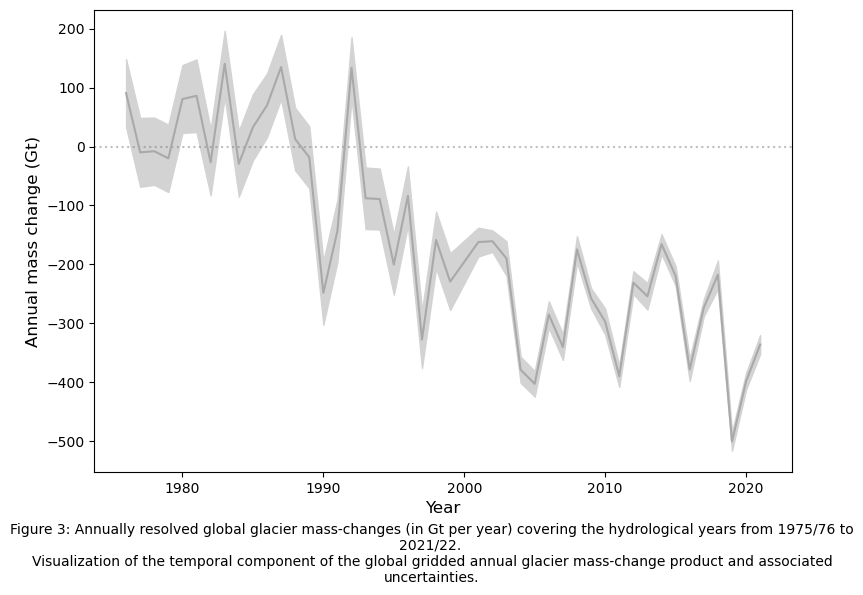
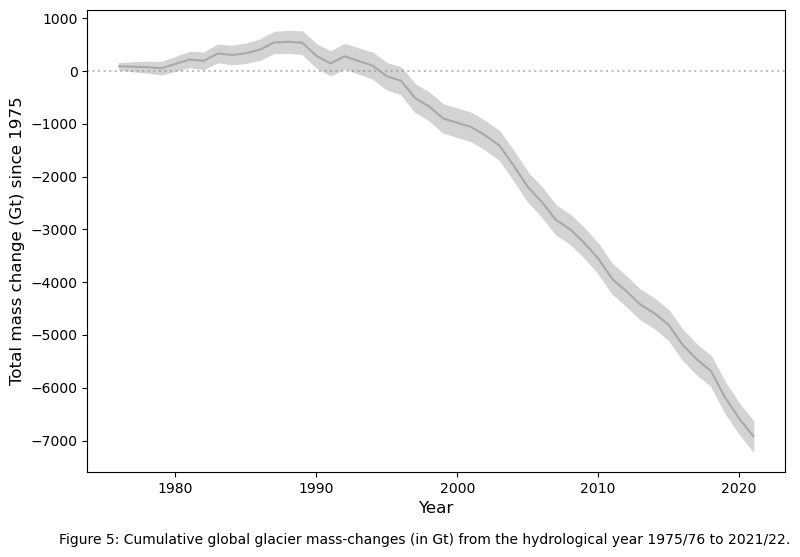
Finaly we will explore different ways of plotting the annual time series of global mass change as mean annual mass change rates and uncertainties, as annual climate warming stripes and as total cumulative global mass changes for the full time period.
Prepare your environment#
The first thing we need to do, is make sure you are ready to run the code while working through this notebook. There are some simple steps you need to do to get yourself set up.
Set up CDSAPI and your credentials#
The code below will ensure that the cdsapi package is installed. If you have not setup your ~/.cdsapirc file with your credentials, you can replace None with your credentials that can be found on the how to api page (you will need to log in to see your credentials).
!pip install -q cdsapi
# If you have already setup your .cdsapirc file you can leave this as None
cdsapi_key = None
cdsapi_url = None
(Install and) Import libraries#
# Import standard libraries
import zipfile
#
# Import third party libraries
import cartopy.crs
import cdsapi
import IPython
import matplotlib.animation
import matplotlib.colors
import matplotlib.patches
import matplotlib.pyplot
import pandas
import xarray
# Ignore distracting warnings
import warnings
warnings.filterwarnings('ignore')
Explore data#
This notebook uses the glacier mass change Climate Data Record (CDR) “Glacier mass change gridded data from 1976 to present derived from the Fluctuations of Glaciers Database” available through the C3S Glacier Change Service Climate Data Store (CDS).
The Glacier Change Service addresses the Glacier Essential Climate Variable (ECV). The glacier mass change CDR consists of a global gridded product of annual glacier mass changes in gigatonnes (Gt) at a 0.5° x 0.5° (latitude, longitude) spatial resolution based on glacier change observations covering the hydrological years from 1975/76 to 2021/23. The Glacier mass change dataset was computed by combining the temporal variability from glaciological in-situ glacier observations with the multiannual to decadal trends from airborne and spaceborne geodetic glacier mass change observations. It builds upon individual glaciers glaciological and geodetic time series available from the latest version of the Fluctuations of Glaciers (FoG) database produced by the World Glacier Monitoring Service (WGMS) and individual glacier areas from the Randolph Glacier Inventory (RGI version 6.0).
The theoretical basis of the Glacier CDR is described in the CDS dataset documentation (Algorithm Theoretical Basis Document (ATBD), Target Requirements and Gap Analysis Document (TRGAD) and Product Quality Assessment Report (PQAR)). The glaciological and geodetic time series used as input data are extensively discussed in WGMS (2024) and in Zemp et al. (2013, 2015, 2019).
Search for data#
Having selected the correct dataset, we now need to specify what product type, variables, temporal and geographic coverage we are interested in. These parameters can all be selected in the “Download data” tab. In this tab, a form appears in which we can select the following parameters to download:
Parameters of data to download
Variable:
Glacier mass changeProduct version:
WGMS-FOG-2022-09
At the end of the download form, select “Show API request”. This will reveal a block of code, which you can simply copy and paste into a cell of your Jupyter Notebook (see cell below). Having copied the API request into the cell below, running this will retrieve and download the data you requested into your local directory.
Warning
Please remember to accept the terms and conditions of the dataset, at the bottom of the CDS download form!
Download the data#
We will use the Climate Data Store (CDS) API to download the glacier mass change dataset.
# Download data from the CDS
c = cdsapi.Client()
c.retrieve(
name='derived-gridded-glacier-mass-change',
request={
'variable': 'glacier_mass_change',
'product_version': 'wgms_fog_2022_09',
'format': 'zip',
'hydrological_year': [
'1975_76', '1976_77', '1977_78',
'1978_79', '1979_80', '1980_81',
'1981_82', '1982_83', '1983_84',
'1984_85', '1985_86', '1986_87',
'1987_88', '1988_89', '1989_90',
'1990_91', '1991_92', '1992_93',
'1993_94', '1994_95', '1995_96',
'1996_97', '1997_98', '1998_99',
'1999_20', '2000_01', '2001_02',
'2002_03', '2003_04', '2004_05',
'2005_06', '2006_07', '2007_08',
'2008_09', '2009_10', '2010_11',
'2011_12', '2012_13', '2013_14',
'2014_15', '2015_16', '2016_17',
'2017_18', '2018_19', '2019_20',
'2020_21',
],
},
target='glacier_mass_change.zip'
)
2024-09-30 14:33:05,885 INFO [2024-04-29T00:00:00] Version WGMS-FOG-2022-09 will be deprecated in the near future. Users are advised to use the latest version.
2024-09-30 14:33:05,886 INFO Request ID is 01079521-60d3-4ba0-96da-1be58d7c6239
2024-09-30 14:33:05,955 INFO status has been updated to accepted
2024-09-30 14:33:09,821 INFO status has been updated to successful
'glacier_mass_change.zip'
Since the data is downloaded as a zip file, we have to first unzip it.
with zipfile.ZipFile('glacier_mass_change.zip', 'r') as file:
file.extractall('glacier_mass_change')
Inspect data#
The data are formatted as multiple netCDF4 files, one for each year, but they can be read as a single dataset using xarray.
ds = xarray.open_mfdataset('glacier_mass_change/*.nc4')
ds
<xarray.Dataset>
Dimensions: (time: 45, lat: 360, lon: 720)
Coordinates:
* time (time) datetime64[ns] 1976-01-01 1977-01-01 ... 2021-01-01
* lat (lat) float64 89.75 89.25 88.75 88.25 ... -88.75 -89.25 -89.75
* lon (lon) float64 -179.8 -179.2 -178.8 -178.2 ... 178.8 179.2 179.8
Data variables:
Glacier (time, lat, lon) float64 dask.array<chunksize=(1, 360, 720), meta=np.ndarray>
Uncertainty (time, lat, lon) float64 dask.array<chunksize=(1, 360, 720), meta=np.ndarray>
Attributes:
title: Global gridded annual glacier mass change product
project: Copernicus Climate Change Service (C3S) Essential Climate ...
data_version: version-wgms-fog-2022-09
institution: World Glacier Monitoring Service - Geography Department - ...
created_by: Dr. Ines Dussaillant ines.dussaillant@geo.uzh.ch
references: Fluctuation of Glagiers (FoG) database version wgms-fog-20...
citation:
Conventions: CF Version CF-1.8
comment: Brief data description:Horizontal resolution:\t0.5° (latit...Each time value contains a date, but represents a hydrological year. For example, 1976-01-01 represents the 1975–1976 hydrological year. To simplify what follows, we reduce each time to the end year of the hydrological year.
ds['time'] = [date.year for date in ds['time'].values.astype('datetime64[D]').tolist()]
ds['time']
<xarray.DataArray 'time' (time: 45)>
array([1976, 1977, 1978, 1979, 1980, 1981, 1982, 1983, 1984, 1985, 1986, 1987,
1988, 1989, 1990, 1991, 1992, 1993, 1994, 1995, 1996, 1997, 1998, 1999,
2001, 2002, 2003, 2004, 2005, 2006, 2007, 2008, 2009, 2010, 2011, 2012,
2013, 2014, 2015, 2016, 2017, 2018, 2019, 2020, 2021])
Coordinates:
* time (time) int64 1976 1977 1978 1979 1980 ... 2017 2018 2019 2020 2021Plot mass change on a map#
Static map for one year#
We use matplotlib and cartopy to make a map of glacier mass change for one year.
# Select year
YEAR = 2021
# Create a map with a plate carrée projection
figure = matplotlib.pyplot.figure(figsize=(12, 6))
axis = matplotlib.pyplot.axes(projection=cartopy.crs.PlateCarree())
# Add title
axis.set_title(f"Hydrological year {YEAR - 1}–{YEAR}")
# Add latitude, longitude gridlines
axis.gridlines(draw_labels=True, alpha=0.25, linestyle=':', color='white')
# Add white continents against a gray background
axis.set_facecolor('darkgray')
axis.add_feature(cartopy.feature.LAND, facecolor='lightgray')
# Define range and ticks of color scale
ticks = [-1, -0.1, -0.01, 0, 0.01, 0.1, 1]
# Plot mass loss in red and gain in blue
# A log scale is used for colors to highlight differences between regions
im = matplotlib.pyplot.pcolormesh(
ds['lon'],
ds['lat'],
ds['Glacier'].loc[YEAR],
cmap='RdBu',
norm=matplotlib.colors.SymLogNorm(
vmin=ticks[0], vmax=ticks[-1], linthresh=0.01
)
)
# Add a colorbar with custom ticks
cbar = matplotlib.pyplot.colorbar(
im,
fraction=0.025,
pad=0.05,
label='Glacier mass change (Gt)',
ticks=ticks
)
cbar.ax.set_yticklabels([f'< {ticks[0]}', *ticks[1:-1], f'> {ticks[-1]}'])
# Show plot
figure.tight_layout(pad=0)
matplotlib.pyplot.show()
# Print a text describing the figure
txt=(f"Figure 1: Global gridded annual glacier mass-changes (in Gt per year). Visualization example of the gridded glacier change product"
"\n"
f"for the hydrological year {YEAR - 1}–{YEAR}, spatially distributed in a global regular grid of 0.5° (latitude/longitude).")
print(txt)

Figure 1: Global gridded annual glacier mass-changes (in Gt per year). Visualization example of the gridded glacier change product
for the hydrological year 2020–2021, spatially distributed in a global regular grid of 0.5° (latitude/longitude).
Animation for all years#
Using the map above as a template, we create a map for each year and display them in an animation. Make sure to run this cell immediately after the cell above.
The resulting animation shows the global gridded annual glacier mass-changes (in Gt per year) for the hydrological years from 1975/76 to 2021/22.
# Define the animation parameters
def animate(time_index: int) -> None:
im.set_array(ds['Glacier'][time_index].values.ravel())
year = ds['time'].values[time_index]
axis.set_title(f"Hydrological year {year - 1}–{year}")
# Plot static maps for every year and create the animation
animation = matplotlib.animation.FuncAnimation(
figure,
func=animate,
frames=ds['time'].size,
interval=500 # ms
)
# Display animation
IPython.display.HTML(animation.to_jshtml())
Plot timeseries of global mass change#
Compute mean of global change#
The global mass change is the sum of the mass changes reported for each spatial grid cell. We compute it by summing mass change across the latitude (lat) and longitude (lon) dimensions.
# compute mean global glacier mass-change
global_change_mean = ds.sum(dim=['lat', 'lon'])['Glacier']
Compute standard deviation of global change#
If we assume that the mass changes for which we computed the sum above are uncorrelated, the standard deviation of their sum is the square root of the sum of the squares of their standard deviations:
\( f = \textstyle\sum_i m_i \\ \sigma_f = \sqrt {\textstyle\sum_i \sigma_i^2} \)
See Wikipedia: Propagation of uncertainty for more information.
We divide the uncertainty by 1.96 below because the authors report that this value is 1.96 \(\sigma\) (equivalent to a 95% confidence interval for a normal distribution).
# compute standard deviation of global glacier mass-change
global_change_std = ((ds['Uncertainty'] / 1.96) ** 2).sum(dim=['lat', 'lon']) ** 0.5
View timeseries as a table#
We use pandas to tabulate the mean and standard deviation computed above.
# view global annual mass-change time series and standard deviation as a table
print( "Table 1: Yearly mean global glacier mass-changes (in Gt per year) and their related standard deviation (std)" )
pandas.DataFrame({
'year': ds['time'],
'mean': global_change_mean,
'std': global_change_std
})
Table 1: Yearly mean global glacier mass-changes (in Gt per year) and their related standard deviation (std)
| year | mean | std | |
|---|---|---|---|
| 0 | 1976 | 90.711681 | 29.427761 |
| 1 | 1977 | -9.916545 | 29.827922 |
| 2 | 1978 | -7.919292 | 29.135105 |
| 3 | 1979 | -20.050397 | 29.187522 |
| 4 | 1980 | 80.726975 | 29.364131 |
| 5 | 1981 | 86.211509 | 31.511226 |
| 6 | 1982 | -26.793842 | 28.662013 |
| 7 | 1983 | 140.430476 | 28.653894 |
| 8 | 1984 | -29.203053 | 28.564248 |
| 9 | 1985 | 32.698277 | 28.637171 |
| 10 | 1986 | 69.848798 | 27.594141 |
| 11 | 1987 | 134.985990 | 27.841201 |
| 12 | 1988 | 12.617256 | 27.050033 |
| 13 | 1989 | -18.082409 | 26.847752 |
| 14 | 1990 | -248.443006 | 27.656334 |
| 15 | 1991 | -143.120973 | 26.829816 |
| 16 | 1992 | 133.672195 | 26.663257 |
| 17 | 1993 | -87.847944 | 26.652052 |
| 18 | 1994 | -89.210215 | 26.410071 |
| 19 | 1995 | -200.446107 | 26.171569 |
| 20 | 1996 | -83.870737 | 25.528025 |
| 21 | 1997 | -327.845908 | 24.748657 |
| 22 | 1998 | -158.643409 | 24.510523 |
| 23 | 1999 | -229.454042 | 24.563616 |
| 24 | 2001 | -162.298628 | 12.494367 |
| 25 | 2002 | -160.765585 | 9.332476 |
| 26 | 2003 | -190.294174 | 14.942672 |
| 27 | 2004 | -379.090233 | 11.315378 |
| 28 | 2005 | -403.113326 | 11.086587 |
| 29 | 2006 | -285.326933 | 11.548195 |
| 30 | 2007 | -340.458477 | 11.253159 |
| 31 | 2008 | -174.674641 | 11.426205 |
| 32 | 2009 | -257.799645 | 8.735710 |
| 33 | 2010 | -297.322767 | 11.295674 |
| 34 | 2011 | -390.143004 | 9.291715 |
| 35 | 2012 | -231.262888 | 9.896819 |
| 36 | 2013 | -254.336647 | 11.493179 |
| 37 | 2014 | -165.881781 | 8.630415 |
| 38 | 2015 | -219.722406 | 8.452308 |
| 39 | 2016 | -378.749650 | 9.953543 |
| 40 | 2017 | -273.700155 | 7.438282 |
| 41 | 2018 | -217.651581 | 12.309113 |
| 42 | 2019 | -500.817056 | 8.147666 |
| 43 | 2020 | -398.682773 | 7.292266 |
| 44 | 2021 | -336.283551 | 8.161970 |
Plot timeseries#
We use matplotlib to plot the mean and uncertainty of the global mass change for each year.
# Configure the figure
figure, axis = matplotlib.pyplot.subplots(1, 1, figsize=(9, 6))
axis.set_ylabel('Annual mass change (Gt)', fontsize=12)
axis.set_xlabel('Year', fontsize=12)
# Plot a horizontal line at 0 change
axis.axhline(y=0, alpha=0.5, linestyle=':', color='gray')
# Plot the uncertainty as 1.96 standard deviations below and above the mean
axis.fill_between(
x=ds['time'],
y1=global_change_mean - global_change_std * 1.96,
y2=global_change_mean + global_change_std * 1.96,
color='lightgray'
)
# Plot the mean as a line
axis.plot(
ds['time'],
global_change_mean,
color='darkgray'
)
txt=("Figure 3: Annually resolved global glacier mass-changes (in Gt per year) covering the hydrological years from 1975/76 to 2021/22. "
"\n"
"Visualization of the temporal component of the global gridded annual glacier mass-change product and associated uncertainties.")
matplotlib.pyplot.figtext(0.5, -0.07, txt, wrap=True, horizontalalignment='center', fontsize=10)
# Show figure
matplotlib.pyplot.show()
We can also plot this in the style of the popular climate warming stripes.
# Configure the figure
figure, axis = matplotlib.pyplot.subplots(1, 1, figsize=(10, 1))
axis.set_xlim(0, global_change_mean.size)
axis.set_axis_off()
# Define a red (negative) to blue (positive) colorscale
colormap = matplotlib.pyplot.get_cmap('RdBu')
# Saturate colors at -500 and +500 Gt
normalizer = matplotlib.colors.Normalize(vmin=-500, vmax=500)
# Create a colored rectangle for each year
for i, value in enumerate(global_change_mean):
axis.add_patch(matplotlib.patches.Rectangle(
xy=(i, 0), width=1, height=1, facecolor=colormap(normalizer(value))
))
txt=("Figure 4: Climate stripes of annual global glacier mass-changes (in Gt per year) for the hydrological years from 1975/76 to 2021/22." )
matplotlib.pyplot.figtext(0.5, -0.1, txt, wrap=True, horizontalalignment='center', fontsize=10)
# Show figure
matplotlib.pyplot.show()

Plot total global mass change#
Rather than plot the annual mass change, we would like to plot the total mass change accumulated from the beginning of the series to each subsequent year. To do so, we take the cumulative sum of the annual mass changes calculated above. To calculate the standard deviation of this total, we apply the same principle as before.
# compute cumulative global glacier mass-changes and total standard deviation
global_change_total = global_change_mean.cumsum()
global_change_total_std = (global_change_std ** 2).cumsum() ** 0.5
Again, we can use pandas to tabulate the total and its standard deviation.
# view the cummulative global glacier mass-change time series and their standard deviation as a table
print( "Table 2: Cumulative global glacier mass-changes (in Gt per year) and their related standard deviation (total_std)" )
pandas.DataFrame({
'year': ds['time'],
'total': global_change_total,
'total_std': global_change_total_std
})
Table 2: Cumulative global glacier mass-changes (in Gt per year) and their related standard deviation (total_std)
| year | total | total_std | |
|---|---|---|---|
| 0 | 1976 | 90.711681 | 29.427761 |
| 1 | 1977 | 80.795136 | 41.901051 |
| 2 | 1978 | 72.875844 | 51.034816 |
| 3 | 1979 | 52.825448 | 58.791699 |
| 4 | 1980 | 133.552423 | 65.716939 |
| 5 | 1981 | 219.763931 | 72.881228 |
| 6 | 1982 | 192.970089 | 78.314650 |
| 7 | 1983 | 333.400565 | 83.392026 |
| 8 | 1984 | 304.197512 | 88.148433 |
| 9 | 1985 | 336.895789 | 92.683514 |
| 10 | 1986 | 406.744587 | 96.704035 |
| 11 | 1987 | 541.730577 | 100.632017 |
| 12 | 1988 | 554.347833 | 104.204161 |
| 13 | 1989 | 536.265424 | 107.607198 |
| 14 | 1990 | 287.822419 | 111.104373 |
| 15 | 1991 | 144.701446 | 114.297947 |
| 16 | 1992 | 278.373640 | 117.366733 |
| 17 | 1993 | 190.525696 | 120.354817 |
| 18 | 1994 | 101.315481 | 123.218399 |
| 19 | 1995 | -99.130625 | 125.967158 |
| 20 | 1996 | -183.001362 | 128.527837 |
| 21 | 1997 | -510.847270 | 130.888888 |
| 22 | 1998 | -669.490679 | 133.164059 |
| 23 | 1999 | -898.944721 | 135.410627 |
| 24 | 2001 | -1061.243349 | 135.985834 |
| 25 | 2002 | -1222.008934 | 136.305694 |
| 26 | 2003 | -1412.303108 | 137.122302 |
| 27 | 2004 | -1791.393341 | 137.588384 |
| 28 | 2005 | -2194.506667 | 138.034329 |
| 29 | 2006 | -2479.833600 | 138.516557 |
| 30 | 2007 | -2820.292077 | 138.972912 |
| 31 | 2008 | -2994.966718 | 139.441846 |
| 32 | 2009 | -3252.766363 | 139.715214 |
| 33 | 2010 | -3550.089130 | 140.171086 |
| 34 | 2011 | -3940.232134 | 140.478715 |
| 35 | 2012 | -4171.495022 | 140.826902 |
| 36 | 2013 | -4425.831670 | 141.295115 |
| 37 | 2014 | -4591.713451 | 141.558446 |
| 38 | 2015 | -4811.435857 | 141.810560 |
| 39 | 2016 | -5190.185507 | 142.159446 |
| 40 | 2017 | -5463.885663 | 142.353911 |
| 41 | 2018 | -5681.537244 | 142.885095 |
| 42 | 2019 | -6182.354299 | 143.117207 |
| 43 | 2020 | -6581.037072 | 143.302868 |
| 44 | 2021 | -6917.320623 | 143.535117 |
Finally, we use matplotlib to plot the total and its uncertainty.
# Configure the figure
figure, axis = matplotlib.pyplot.subplots(1, 1, figsize=(9, 6))
start_year = ds['time'].values[0] - 1
axis.set_ylabel(f"Total mass change (Gt) since {start_year}", fontsize=12)
axis.set_xlabel('Year', fontsize=12)
# Plot a horizontal line at 0 change
axis.axhline(y=0, alpha=0.5, linestyle=':', color='gray')
# Plot the uncertainty as 1.96 standard deviations
axis.fill_between(
x=ds['time'],
y1=global_change_total - global_change_total_std * 1.96,
y2=global_change_total + global_change_total_std * 1.96,
color='lightgray'
)
# Plot the mean as a line
axis.plot(
ds['time'],
global_change_total,
color='darkgray'
)
txt=("Figure 5: Cumulative global glacier mass-changes (in Gt) from the hydrological year 1975/76 to 2021/22.")
matplotlib.pyplot.figtext(0.5, -0.01, txt, wrap=True, horizontalalignment='center', fontsize=10)
# Show figure
matplotlib.pyplot.show()
Take home messages 📌#
You are ready to use the Climate Data Store (CDS) glacier mass change dataset to explore how global glaciers have evolved over the last 5 decades.
You know how to plot global glacier-changes in a map and observe how the worlds glaciers have evolved year by year on an animated map from 1976 to 2021.
You also know how to plot global glacier mass-changes in different ways, as animations, mean annual mass change-rates, climate warming stripes or as the total cumulative global mass changes since 1976.
Enjoy playing with the glacier mass change dataset!
References#
WGMS (2024). Fluctuations of Glaciers Database. doi: 10.5904/wgms-fog-2024-01
Zemp, M., Thibert, E., Huss, M., Stumm, D., Rolstad Denby, C., Nuth, C., et al. (2013). Reanalysing glacier mass balance measurement series. The Cryosphere 7, 1227–1245. doi: 10.5194/tc-7-1227-2013.
Zemp, M., Frey, H., Gärtner-Roer, I., Nussbaumer, S. U., Hoelzle, M., Paul, F., et al. (2015). Historically unprecedented global glacier decline in the early 21st century. Journal of Glaciology 61, 745–762. doi: 10.3189/2015JoG15J017.
Zemp, M., Huss, M., Thibert, E., Eckert, N., McNabb, R., Huber, J., et al. (2019). Global glacier mass changes and their contributions to sea-level rise from 1961 to 2016. Nature 568, 382. doi: 10.1038/s41586-019-1071-0.