In this tutorial, we combine the drought hazard (here: drought duration) with agricultural land cover data to estimate the area of agricultural land exposed to drought in Central Greece (NUTS2 region EL64). Agricultural drought exposure is a key component of risk assessments for the agricultural sector.
We use two complementary land cover datasets:
CORINE Land Cover: European land cover maps (1990, 2000, 2006, 2012, 2018)
Satellite Land Cover: Global annual satellite-based land cover (1992–2022)
For future projections we assume persistence: the most recently observed agricultural fraction is held constant to 2100. In the final section we explore sensitivity to different land use trajectories.
For more detail on the land cover datasets, see the Agricultural Land reference page. For more detail on the drought duration indicator, see the ECDE reference page.
Setup
import os
import pandas as pd
import matplotlib.pyplot as plt
import matplotlib.patches as mpatches
from matplotlib.lines import Line2D
import numpy as np
from pathlib import Path
from scipy import stats

plt.rcParams['figure.figsize'] = (12, 6)
plt.rcParams['font.size'] = 11Settings
# Configuration
admin_id = 'EL64'

# Reference period (WMO standard: 1991-2020)
baseline_start = 1991
baseline_end   = 2020

# Paths (relative to the tutorials/ folder)
data_dir           = Path('../data') / admin_id
drought_reanalysis = data_dir / 'drought_hazard' / f'drought_duration_reanalysis_{admin_id}.csv'
drought_proj_path  = data_dir / 'drought_hazard' / f'drought_duration_projections_{admin_id}.csv'
corine_agri_csv    = data_dir / 'corine_land_cover' / 'land_cover_categories.csv'
satellite_agri_csv = data_dir / 'satellite_land_cover' / f'agricultural_land_fraction_{admin_id}.csv'

print(f'Region: {admin_id} (Central Greece)')
print('\nData files:')
for f in [drought_reanalysis, drought_proj_path, corine_agri_csv, satellite_agri_csv]:
    print(f'  {f}')
Region: EL64 (Central Greece)

Data files:
  ../data/EL64/drought_hazard/drought_duration_reanalysis_EL64.csv
  ../data/EL64/drought_hazard/drought_duration_projections_EL64.csv
  ../data/EL64/corine_land_cover/land_cover_categories.csv
  ../data/EL64/satellite_land_cover/agricultural_land_fraction_EL64.csv
Load Data
# Drought reanalysis
drought_hist_df = pd.read_csv(drought_reanalysis)
drought_hist_df['time'] = pd.to_datetime(drought_hist_df['time'])
drought_hist_df['year'] = drought_hist_df['time'].dt.year

# Drought projections
drought_proj_df = pd.read_csv(drought_proj_path)
drought_proj_df['time'] = pd.to_datetime(drought_proj_df['time'])
drought_proj_df['year'] = drought_proj_df['time'].dt.year

print(f'Drought reanalysis : {drought_hist_df["year"].min()}-{drought_hist_df["year"].max()}')
print(f'Drought projections: {drought_proj_df["year"].min()}-{drought_proj_df["year"].max()}')
print(f'Climate models     : {drought_proj_df["model"].nunique()}')
print(f'Scenarios          : {sorted(drought_proj_df["scenario"].unique())}')
Drought reanalysis : 1940-2023
Drought projections: 1950-2100
Climate models     : 18
Scenarios          : ['RCP4_5', 'RCP8_5']
# CORINE land cover (5 snapshot years; 'agricultural' column in %)
df_corine = pd.read_csv(corine_agri_csv)
df_corine['ag_fraction'] = df_corine['agricultural'] / 100.0

# Satellite land cover (annual 1992-2022; ag_fraction already in 0-1)
df_satellite = pd.read_csv(satellite_agri_csv)

print('CORINE land cover (snapshot years):')
print(df_corine[['year', 'agricultural', 'ag_fraction']].to_string(index=False))
print(f'\nSatellite land cover: {int(df_satellite["year"].min())}-{int(df_satellite["year"].max())} '
      f'({len(df_satellite)} years)')
print(f'  Latest ag_fraction: {df_satellite["ag_fraction"].iloc[-1]:.4f}')
CORINE land cover (snapshot years):
 year  agricultural  ag_fraction
 1990     33.279219     0.332792
 2000     33.257153     0.332572
 2006     32.446728     0.324467
 2012     31.755714     0.317557
 2018     31.745346     0.317453

Satellite land cover: 1992-2022 (31 years)
  Latest ag_fraction: 0.2769
Part 1: Historical Agricultural Drought Exposure
We estimate historical agricultural drought exposure as:
where drought duration comes from ERA5 reanalysis and the agricultural fraction from each land cover dataset. The result is an agricultural drought exposure index in months yr⁻¹ × fraction, representing the drought-weighted share of the region under agricultural use in a given year.
Because CORINE provides only five snapshot years, we forward-fill the fraction between snapshots, consistent with the persistence assumption used in the projections (Part 2).
# Build a full annual CORINE series by forward-filling the 5 snapshot values
all_hist_years = pd.DataFrame({'year': range(drought_hist_df['year'].min(),
                                             drought_hist_df['year'].max() + 1)})
corine_annual = all_hist_years.merge(df_corine[['year', 'ag_fraction']], on='year', how='left')
corine_annual['ag_fraction'] = corine_annual['ag_fraction'].ffill()

# Merge with drought reanalysis
hist_corine = drought_hist_df[['year', 'dmd']].merge(corine_annual, on='year', how='inner')
hist_corine['exposure'] = hist_corine['dmd'] * hist_corine['ag_fraction']

hist_satellite = drought_hist_df[['year', 'dmd']].merge(
    df_satellite[['year', 'ag_fraction']], on='year', how='inner')
hist_satellite['exposure'] = hist_satellite['dmd'] * hist_satellite['ag_fraction']

bl_corine    = hist_corine[hist_corine['year'].between(baseline_start, baseline_end)]
bl_satellite = hist_satellite[hist_satellite['year'].between(baseline_start, baseline_end)]

print(f'Historical CORINE exposure   : {hist_corine["year"].min()}-{hist_corine["year"].max()}')
print(f'Historical satellite exposure: {hist_satellite["year"].min()}-{hist_satellite["year"].max()}')
print(f'\nBaseline ({baseline_start}-{baseline_end}) mean exposure:')
print(f'  CORINE   : {bl_corine["exposure"].mean():.4f} months/yr\u00b7fraction')
print(f'  Satellite: {bl_satellite["exposure"].mean():.4f} months/yr\u00b7fraction')
Historical CORINE exposure   : 1940-2023
Historical satellite exposure: 1992-2022

Baseline (1991-2020) mean exposure:
  CORINE   : 0.4088 months/yr·fraction
  Satellite: 0.3692 months/yr·fraction
fig, axes = plt.subplots(3, 1, figsize=(14, 11), sharex=True)

# Panel 1: drought duration
axes[0].plot(hist_corine['year'], hist_corine['dmd'],
             color='#D62828', linewidth=1.5, alpha=0.8, label='ERA5 reanalysis')
axes[0].set_ylabel('Drought duration\n(months/year)', fontsize=11)
axes[0].set_title('Historical Agricultural Drought Exposure \u2014 Central Greece (EL64)',
                  fontsize=14, fontweight='bold', pad=15)
axes[0].legend(fontsize=10)
axes[0].grid(True, alpha=0.3, linestyle='--', linewidth=0.5)
axes[0].spines['top'].set_visible(False)
axes[0].spines['right'].set_visible(False)

# Panel 2: agricultural fraction
axes[1].step(hist_corine['year'], hist_corine['ag_fraction'],
             color='#8B4513', linewidth=2, where='post', label='CORINE (forward-filled)')
axes[1].plot(hist_satellite['year'], hist_satellite['ag_fraction'],
             color='#228B22', linewidth=1.5, label='Satellite (annual)')
axes[1].scatter(df_corine['year'], df_corine['ag_fraction'],
                color='#8B4513', s=60, zorder=5, label='CORINE snapshots')
axes[1].set_ylabel('Agricultural fraction\n(0\u20131)', fontsize=11)
axes[1].legend(fontsize=10)
axes[1].grid(True, alpha=0.3, linestyle='--', linewidth=0.5)
axes[1].spines['top'].set_visible(False)
axes[1].spines['right'].set_visible(False)

# Panel 3: exposure index
axes[2].fill_between(hist_corine['year'], 0, hist_corine['exposure'],
                     color='#8B4513', alpha=0.3)
axes[2].plot(hist_corine['year'], hist_corine['exposure'],
             color='#8B4513', linewidth=2, label='CORINE')
axes[2].fill_between(hist_satellite['year'], 0, hist_satellite['exposure'],
                     color='#228B22', alpha=0.2)
axes[2].plot(hist_satellite['year'], hist_satellite['exposure'],
             color='#228B22', linewidth=2, label='Satellite')
axes[2].axvspan(baseline_start, baseline_end, color='gray', alpha=0.1,
                label=f'Baseline ({baseline_start}\u2013{baseline_end})')
axes[2].set_ylabel('Agricultural drought\nexposure (months/yr\u00b7fraction)', fontsize=11)
axes[2].set_xlabel('Year', fontsize=12)
axes[2].legend(fontsize=10)
axes[2].grid(True, alpha=0.3, linestyle='--', linewidth=0.5)
axes[2].spines['top'].set_visible(False)
axes[2].spines['right'].set_visible(False)

plt.tight_layout()
plt.show()
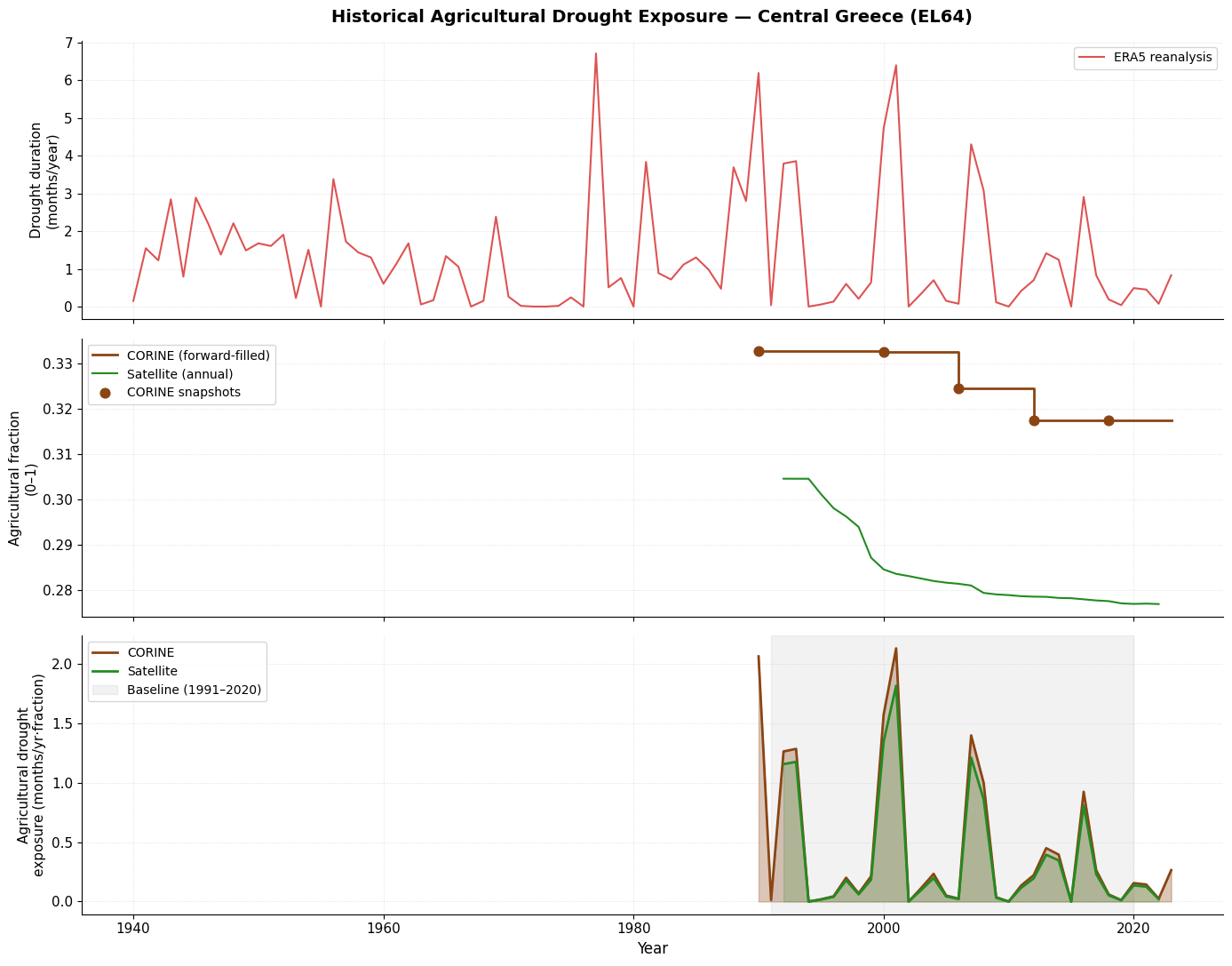
Figure: Historical agricultural drought exposure for Central Greece (EL64). Top panel: annual drought duration from ERA5 reanalysis. Middle panel: agricultural fraction from CORINE Land Cover (forward-filled between five snapshot years; dots mark the snapshots) and from satellite land cover (annual series). Bottom panel: agricultural drought exposure index (drought duration × agricultural fraction) for both datasets; the grey shading marks the 1991–2020 reference period.
Dataset comparison
Both datasets track the same drought signal but diverge in magnitude of the agricultural fraction (CORINE ~32 %, satellite ~28 % for EL64). This offset is a known consequence of classification differences and spatial resolution rather than an actual land use discrepancy. Despite the offset, the temporal pattern of agricultural drought exposure is consistent across both datasets.
overlap = hist_corine.merge(hist_satellite[['year', 'ag_fraction', 'exposure']],
                            on='year', suffixes=('_corine', '_sat'))

print('Comparison over overlapping years:')
print(f'  Mean CORINE ag fraction   : {overlap["ag_fraction_corine"].mean():.4f}')
print(f'  Mean satellite ag fraction: {overlap["ag_fraction_sat"].mean():.4f}')
diff_pp = (overlap['ag_fraction_corine'] - overlap['ag_fraction_sat']) * 100
print(f'  Mean offset (CORINE - satellite): {diff_pp.mean():+.2f} pp')
print(f'\nBaseline ({baseline_start}-{baseline_end}) mean exposure:')
print(f'  CORINE   : {bl_corine["exposure"].mean():.4f} months/yr\u00b7fraction')
print(f'  Satellite: {bl_satellite["exposure"].mean():.4f} months/yr\u00b7fraction')
ratio = bl_corine['exposure'].mean() / bl_satellite['exposure'].mean()
print(f'  Ratio (CORINE / Satellite): {ratio:.2f}')
Comparison over overlapping years:
  Mean CORINE ag fraction   : 0.3257
  Mean satellite ag fraction: 0.2845
  Mean offset (CORINE - satellite): +4.12 pp

Baseline (1991-2020) mean exposure:
  CORINE   : 0.4088 months/yr·fraction
  Satellite: 0.3692 months/yr·fraction
  Ratio (CORINE / Satellite): 1.11
Part 2: Future Agricultural Drought Exposure Under Climate Change
We project future exposure by combining:
Climate model projections of drought duration (multiple models × RCP4.5 / RCP8.5)
Agricultural fraction held constant at the latest observed value (persistence assumption)
The persistence assumption means no land-use change is assumed after the last observation:
CORINE: 2018 value (~31.75 %)
Satellite: 2022 value (~27.69 %)
Any increase in future agricultural drought exposure therefore arises entirely from climate change.
To have consistent data, let’s create a timeseries that has observed values where available, and backward- and forward fills with persistence (of the first and last observed value).
# Full year range: union of reanalysis and projection years
all_years_combined = sorted(set(drought_hist_df['year'].tolist() + drought_proj_df['year'].tolist()))
year_df = pd.DataFrame({'year': all_years_combined})

# CORINE: use the 5 snapshot values; forward-fill between snapshots,
#         backward-fill before 1990 with the 1990 value
corine_full = year_df.merge(df_corine[['year', 'ag_fraction']], on='year', how='left')
corine_full['ag_fraction'] = corine_full['ag_fraction'].ffill().bfill()
ag_frac_corine_dict = dict(zip(corine_full['year'], corine_full['ag_fraction']))

# Satellite: annual 1992-2022; backward-fill before 1992, forward-fill after 2022
sat_full = year_df.merge(df_satellite[['year', 'ag_fraction']], on='year', how='left')
sat_full['ag_fraction'] = sat_full['ag_fraction'].ffill().bfill()
ag_frac_sat_dict = dict(zip(sat_full['year'], sat_full['ag_fraction']))

print(f'CORINE dict (filled) : {min(ag_frac_corine_dict)}–{max(ag_frac_corine_dict)} ({len(ag_frac_corine_dict)} years)')
print(f'Satellite dict (filled): {min(ag_frac_sat_dict)}–{max(ag_frac_sat_dict)} ({len(ag_frac_sat_dict)} years)')
print(f'\nCORINE   first/last observation: {ag_frac_corine_dict[min(ag_frac_corine_dict)]:.4f} ({int(df_corine["year"].iloc[0])}) / {ag_frac_corine_dict[max(ag_frac_corine_dict)]:.4f} ({int(df_corine["year"].iloc[-1])})')
print(f'Satellite first/last observation: {ag_frac_sat_dict[min(ag_frac_sat_dict)]:.4f} ({int(df_satellite["year"].iloc[0])}) / {ag_frac_sat_dict[max(ag_frac_sat_dict)]:.4f} ({int(df_satellite["year"].iloc[-1])})')
CORINE dict (filled) : 1940–2100 (161 years)
Satellite dict (filled): 1940–2100 (161 years)
CORINE first/last observation: 0.3328 (1990) / 0.3175 (2018)
Satellite first/last observation: 0.3046 (1992) / 0.2769 (2022)
fig, ax = plt.subplots(figsize=(14, 5))

corine_years = corine_full['year'].values
corine_frac  = corine_full['ag_fraction'].values * 100
sat_years    = sat_full['year'].values
sat_frac     = sat_full['ag_fraction'].values * 100

first_corine_year = int(df_corine['year'].min())   # 1990
first_sat_year    = int(df_satellite['year'].min()) # 1992

# --- CORINE ---
# Full range as dashed (gap-filled regions will show through)
ax.step(corine_years, corine_frac,
        color='#8B4513', linewidth=1.5, linestyle='--', where='post', alpha=0.5,
        label='CORINE (gap-filled: persistence)')
# Overplot observed region (1990–2018, forward-filled between snapshots) as solid
mask_c = (corine_years >= first_corine_year) & (corine_years <= last_corine_year)
ax.step(corine_years[mask_c], corine_frac[mask_c],
        color='#8B4513', linewidth=2.5, where='post',
        label=f'CORINE (observed, {first_corine_year}–{last_corine_year})')
# Snapshot dots
ax.scatter(df_corine['year'], df_corine['ag_fraction'] * 100,
           color='#8B4513', s=70, zorder=10, label='CORINE snapshots')

# --- Satellite ---
# Full range as dashed
ax.plot(sat_years, sat_frac,
        color='#228B22', linewidth=1.5, linestyle='--', alpha=0.5,
        label='Satellite (gap-filled: persistence)')
# Overplot observed region (1992–2022) as solid
mask_s = (sat_years >= first_sat_year) & (sat_years <= last_satellite_year)
ax.plot(sat_years[mask_s], sat_frac[mask_s],
        color='#228B22', linewidth=2.5,
        label=f'Satellite (observed, {first_sat_year}–{last_satellite_year})')

# Mark observation boundaries with faint vertical lines
for yr, color in [
    (first_corine_year, '#8B4513'), (last_corine_year, '#8B4513'),
    (first_sat_year,    '#228B22'), (last_satellite_year, '#228B22'),
]:
    ax.axvline(yr, color=color, linestyle=':', linewidth=1, alpha=0.4)

ax.set_ylabel('Agricultural fraction (%)', fontsize=11)
ax.set_xlabel('Year', fontsize=11)
ax.set_title(
    f'Agricultural land fraction — {admin_id}\n'
    'Solid lines: observed data  |  Dashed lines: persistence gap-fill (backward / forward)',
    fontsize=12, fontweight='bold'
)
ax.legend(fontsize=10, loc='upper right')
ax.grid(True, alpha=0.3, linestyle='--')
ax.spines['top'].set_visible(False)
ax.spines['right'].set_visible(False)
plt.tight_layout()
plt.show()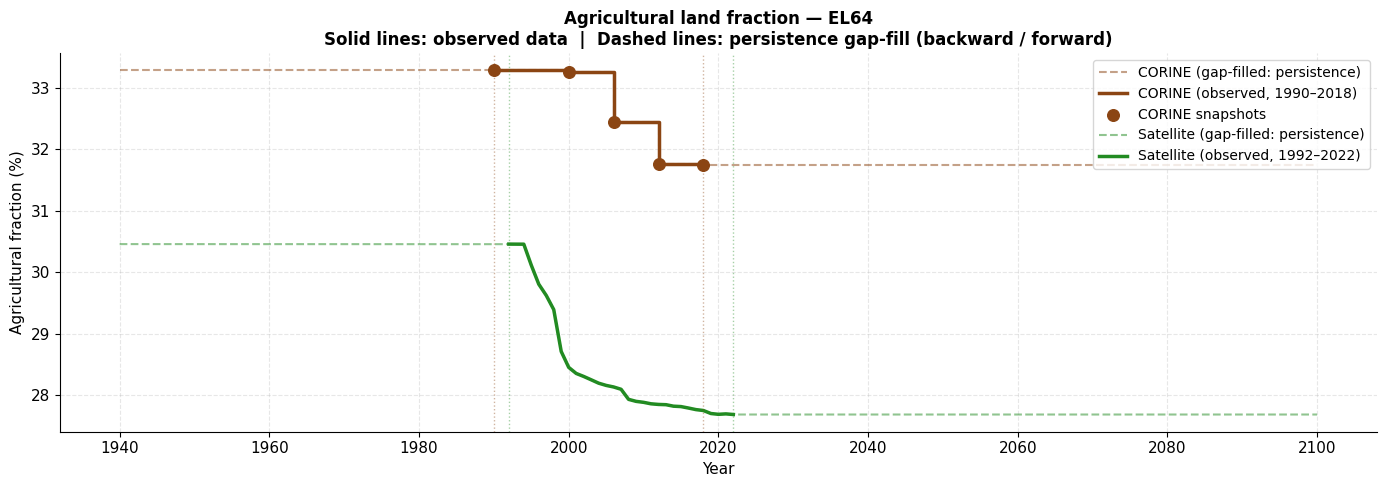
Figure: Agricultural land fraction for Central Greece (EL64) over the full 1950–2100 period. Solid lines show observed data: CORINE Land Cover (brown, 1990–2018, forward-filled between five snapshot years; dots mark the snapshots) and satellite land cover (green, 1992–2022). Dashed lines show persistence gap-fills: the 1990 CORINE value is held constant backward before 1990, and the 2018 CORINE and 2022 satellite values are held constant forward after their respective last observations. Faint dotted vertical lines mark the start and end of each observed record.
We define a helper function that: (1) maps the year-by-year agricultural fraction from the full timeseries dicts onto each model’s drought series, (2) computes raw exposure as dmd × ag_frac for every model and year, (3) applies a 30-year rolling mean to that exposure series, and (4) aggregates multi-model statistics. We run it for both land cover datasets and both RCP scenarios.
def make_exposure_stats(drought_df, ag_frac_dict, scenario, smooth_window=30):
    """Return per-year exposure statistics for a time-varying ag fraction and one RCP scenario.
    Order of operations: (1) raw exposure = dmd × ag_frac per model per year,
    (2) rolling mean applied to the exposure series, (3) multi-model aggregation."""
    df = drought_df[drought_df['scenario'] == scenario].copy()
    df['ag_frac'] = df['year'].map(ag_frac_dict)
    df['exposure_raw'] = df['dmd'] * df['ag_frac']
    df['exposure'] = df.groupby('model')['exposure_raw'].transform(
        lambda x: x.rolling(window=smooth_window, center=True, min_periods=1).mean()
    )
    stats_out = df.groupby('year').agg(
        exposure_median=('exposure', 'median'),
        exposure_p17=('exposure', lambda x: np.percentile(x, 17)),
        exposure_p83=('exposure', lambda x: np.percentile(x, 83)),
    ).reset_index()
    return df, stats_out

# CORINE (full timeseries: observed snapshots + persistence backward/forward)
rcp45_raw_corine, rcp45_stats_corine = make_exposure_stats(drought_proj_df, ag_frac_corine_dict, 'RCP4_5')
rcp85_raw_corine, rcp85_stats_corine = make_exposure_stats(drought_proj_df, ag_frac_corine_dict, 'RCP8_5')

# Satellite (full timeseries: observed annual + persistence backward/forward)
rcp45_raw_sat, rcp45_stats_sat = make_exposure_stats(drought_proj_df, ag_frac_sat_dict, 'RCP4_5')
rcp85_raw_sat, rcp85_stats_sat = make_exposure_stats(drought_proj_df, ag_frac_sat_dict, 'RCP8_5')

print('Exposure statistics computed (exposure = dmd × ag_frac per model per year, then 30-year rolling mean).')
print(f'Projection range: {rcp45_stats_corine["year"].min()}-{rcp45_stats_corine["year"].max()}')
Exposure statistics computed (exposure = dmd × ag_frac per model per year, then 30-year rolling mean).
Projection range: 1950-2100
We overlay historical exposure with projected ensemble spread in a two-panel chart (one panel per land cover dataset), so the offset in absolute values is immediately visible alongside the projected trajectories.
fig, axes = plt.subplots(2, 1, figsize=(14, 10), sharex=True)

# Smooth historical drought for visual consistency with 30-yr rolling mean projections
hist_smooth = drought_hist_df[['year', 'dmd']].copy()
hist_smooth['dmd'] = hist_smooth['dmd'].rolling(window=30, center=True, min_periods=1).mean()

def add_panel(ax, hist_df, stats45, stats85, hist_label, frac_val, frac_year, frac_color, title):
    ax.plot(hist_df['year'], hist_df['exposure'],
            color='black', linewidth=2.5, label=hist_label, zorder=5)
    for color, stats_df, label in [
        ('#F77F00', stats45, 'RCP4.5 (multi-model median)'),
        ('#D62828', stats85, 'RCP8.5 (multi-model median)'),
    ]:
        ax.plot(stats_df['year'], stats_df['exposure_median'],
                color=color, linewidth=2.5, label=label)
        ax.fill_between(stats_df['year'],
                        stats_df['exposure_p17'], stats_df['exposure_p83'],
                        color=color, alpha=0.15)
    ax.axvspan(baseline_start, baseline_end, color='gray', alpha=0.1,
               label=f'Baseline ({baseline_start}\u2013{baseline_end})')
    ax.axvline(frac_year, color=frac_color, linestyle=':', linewidth=1.5,
               label=f'Last observation ({frac_year})')
    ax.set_ylabel('Agricultural drought\nexposure (months/yr\u00b7fraction)', fontsize=11)
    ax.set_title(title, fontsize=12, fontweight='bold')
    ax.legend(fontsize=9, loc='upper left')
    ax.grid(True, alpha=0.3, linestyle='--', linewidth=0.5)
    ax.spines['top'].set_visible(False)
    ax.spines['right'].set_visible(False)

# Use the full timeseries (corine_full / sat_full) for historical exposure,
# consistent with how the projection stats are computed.
hist_corine_smooth = hist_smooth.merge(
    corine_full[['year', 'ag_fraction']], on='year', how='inner')
hist_corine_smooth['exposure'] = hist_corine_smooth['dmd'] * hist_corine_smooth['ag_fraction']

hist_sat_smooth = hist_smooth.merge(
    sat_full[['year', 'ag_fraction']], on='year', how='inner')
hist_sat_smooth['exposure'] = hist_sat_smooth['dmd'] * hist_sat_smooth['ag_fraction']

add_panel(axes[0], hist_corine_smooth, rcp45_stats_corine, rcp85_stats_corine,
          'Historical (reanalysis)', ag_frac_corine, last_corine_year, '#8B4513',
          'CORINE (observed snapshots + persistence fill)')

add_panel(axes[1], hist_sat_smooth, rcp45_stats_sat, rcp85_stats_sat,
          'Historical (reanalysis)', ag_frac_satellite, last_satellite_year, '#228B22',
          'Satellite (observed annual + persistence fill)')

axes[1].set_xlabel('Year', fontsize=12)
fig.suptitle('Future Agricultural Drought Exposure \u2014 Central Greece (EL64)',

             fontsize=14, fontweight='bold', y=1.01)

plt.tight_layout()
plt.show()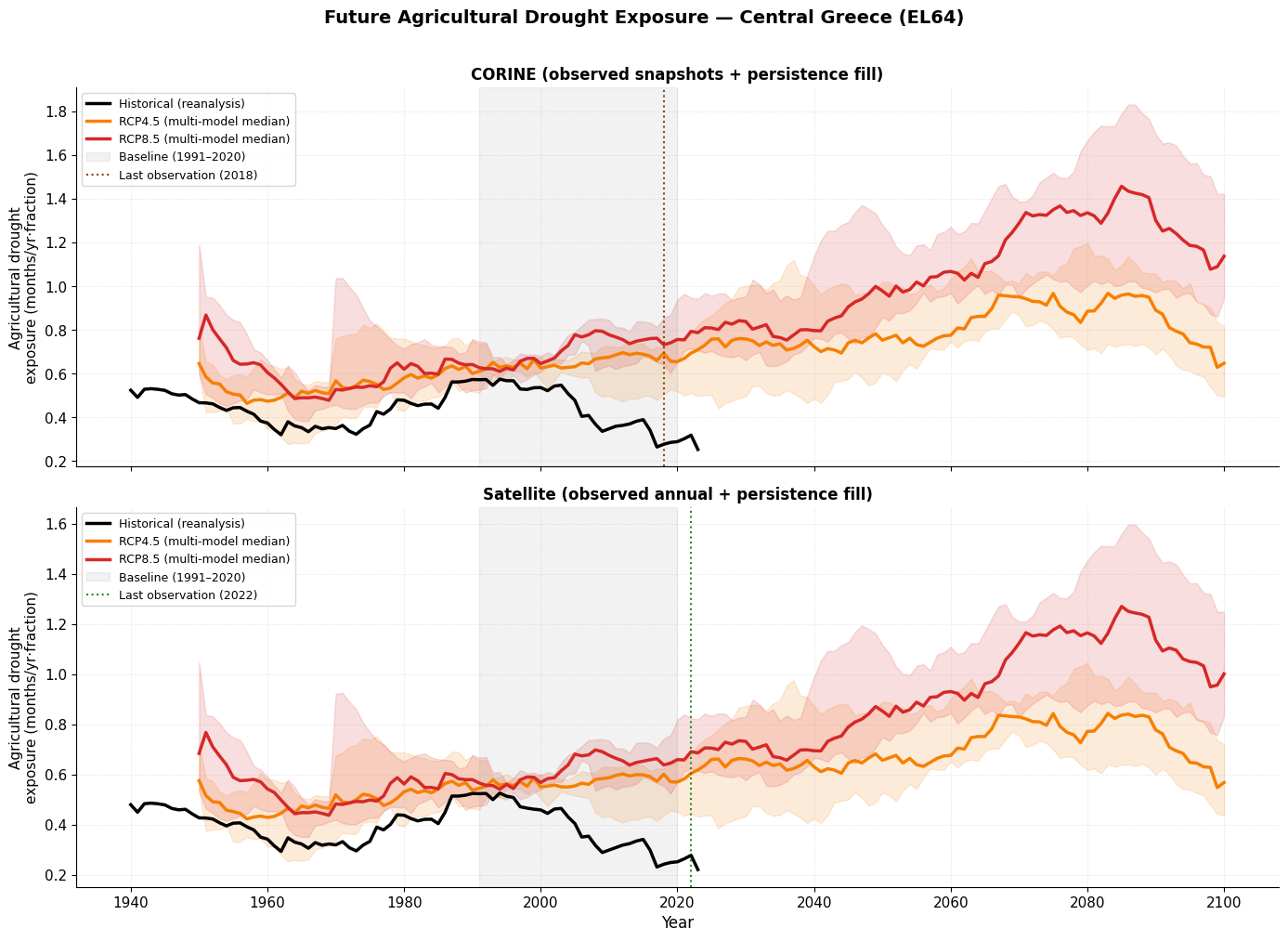
Figure: Historical (black) and projected agricultural drought exposure for Central Greece (EL64), shown separately for CORINE-based (top) and satellite-based (bottom) land cover. Thick coloured lines show the multi-model median for RCP4.5 (orange) and RCP8.5 (red); shading shows the 17–83 percentile range across climate models. The dotted vertical line marks the last land cover observation year, after which the agricultural fraction is held constant at its observed value (persistence assumption). The grey shading marks the 1991–2020 reference period.
A note on the historical divergence between reanalysis and model simulations
The projection plots above show slightly diverging trend for exposure between the models and the reanalysis, especially after the year 2000. Since the agricultural fraction is the same for both (it comes from the same observed timeseries), the offset must be driven by differences in drought duration between the ERA5 reanalysis and the climate model simulations.
This is a well-known feature of regional climate model ensembles: simulated drought duration over the historical period can differ from the reanalysis, both because models simulate their own internal climate variability and because they are tuned to reproduce large-scale circulation patterns rather than local observed trends. The comparison below confirms whether and by how much the models overestimate drought duration in the historical period.
# Compare reanalysis vs. model drought duration over the overlapping historical period
hist_end = int(drought_hist_df['year'].max())

# Reanalysis: 30-yr rolling mean on raw dmd
dmd_reanalysis = drought_hist_df[['year', 'dmd']].copy()
dmd_reanalysis['dmd_smooth'] = dmd_reanalysis['dmd'].rolling(30, center=True, min_periods=1).mean()

# Model ensemble: per-model 30-yr rolling mean, then multi-model stats
def dmd_model_stats(drought_df, scenario):
    df = drought_df[drought_df['scenario'] == scenario].copy()
    df['dmd_smooth'] = df.groupby('model')['dmd'].transform(
        lambda x: x.rolling(30, center=True, min_periods=1).mean()
    )
    return df.groupby('year').agg(
        dmd_median=('dmd_smooth', 'median'),
        dmd_p17=('dmd_smooth', lambda x: np.percentile(x, 17)),
        dmd_p83=('dmd_smooth', lambda x: np.percentile(x, 83)),
    ).reset_index()

dmd_stats45 = dmd_model_stats(drought_proj_df, 'RCP4_5')
dmd_stats85 = dmd_model_stats(drought_proj_df, 'RCP8_5')

# Restrict to historical overlap
overlap_start = int(drought_proj_df['year'].min())
dmd_stats45_hist = dmd_stats45[dmd_stats45['year'] <= hist_end]
dmd_stats85_hist = dmd_stats85[dmd_stats85['year'] <= hist_end]

fig, ax = plt.subplots(figsize=(14, 5))
ax.plot(dmd_reanalysis['year'], dmd_reanalysis['dmd_smooth'],
        color='black', linewidth=2.5, label='ERA5 reanalysis', zorder=5)

for color, df_hist, label in [
    ('#F77F00', dmd_stats45_hist, 'RCP4.5 models (multi-model median)'),
    ('#D62828', dmd_stats85_hist, 'RCP8.5 models (multi-model median)'),
]:
    ax.plot(df_hist['year'], df_hist['dmd_median'], color=color, linewidth=2, label=label)
    ax.fill_between(df_hist['year'], df_hist['dmd_p17'], df_hist['dmd_p83'],
                    color=color, alpha=0.15)

ax.axvspan(baseline_start, baseline_end, color='gray', alpha=0.1,
           label=f'Baseline ({baseline_start}–{baseline_end})')
ax.set_ylabel('Drought duration\n(months/yr, 30-yr rolling mean)', fontsize=11)
ax.set_xlabel('Year', fontsize=11)
ax.set_title(
    f'Historical drought duration: ERA5 reanalysis vs. climate model ensemble — {admin_id}',
    fontsize=12, fontweight='bold'
)
ax.legend(fontsize=10, loc='upper left')
ax.grid(True, alpha=0.3, linestyle='--', linewidth=0.5)
ax.spines['top'].set_visible(False)
ax.spines['right'].set_visible(False)
plt.tight_layout()
plt.show()

# Quantify the baseline offset
bl_era5   = dmd_reanalysis[dmd_reanalysis['year'].between(baseline_start, baseline_end)]['dmd'].mean()
bl_m45    = dmd_stats45[dmd_stats45['year'].between(baseline_start, baseline_end)]['dmd_median'].mean()
bl_m85    = dmd_stats85[dmd_stats85['year'].between(baseline_start, baseline_end)]['dmd_median'].mean()
print(f'Mean drought duration over {baseline_start}–{baseline_end} baseline:')
print(f'  ERA5 reanalysis        : {bl_era5:.3f} months/yr')
print(f'  RCP4.5 multi-model median: {bl_m45:.3f} months/yr  (ratio: {bl_m45/bl_era5:.2f}×)')
print(f'  RCP8.5 multi-model median: {bl_m85:.3f} months/yr  (ratio: {bl_m85/bl_era5:.2f}×)')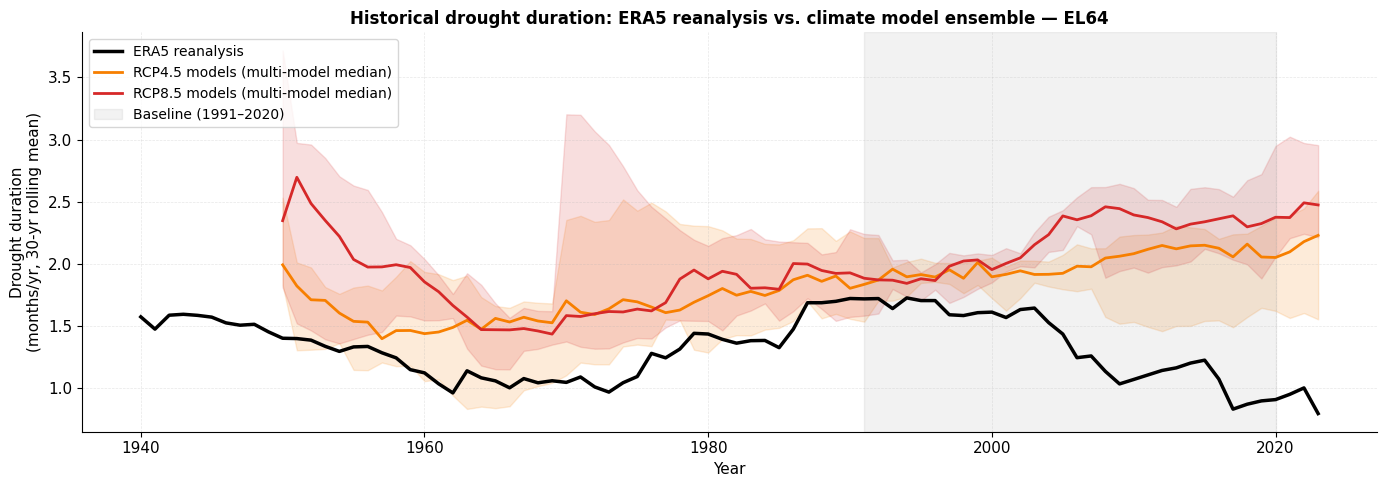
Mean drought duration over 1991–2020 baseline:
  ERA5 reanalysis        : 1.247 months/yr
  RCP4.5 multi-model median: 2.001 months/yr  (ratio: 1.60×)
  RCP8.5 multi-model median: 2.183 months/yr  (ratio: 1.75×)
Figure: Comparison of 30-year rolling mean drought duration from ERA5 reanalysis (black) and the climate model ensemble for RCP4.5 (orange) and RCP8.5 (red) over the historical period. Shading shows the 17–83 percentile range across models. The grey band marks the 1991–2020 baseline.
Near-, mid-, and long-term changes
We evaluate changes in three 30-year future windows relative to the 1991–2020 baseline:
Near-term: 2021–2050
Mid-term: 2041–2070
Long-term: 2071–2100
Because agricultural fraction is held constant (persistence), changes in exposure factor are driven entirely by changes in drought hazard.
factor_periods = {
    'Near-term':  (2021, 2050),
    'Mid-term':   (2041, 2070),
    'Long-term':  (2071, 2100),
}
period_order = ['Near-term', 'Mid-term', 'Long-term']

# Per-model baseline dmd (average across both scenarios)
baseline_dmd_models = (
    drought_proj_df[drought_proj_df['year'].between(baseline_start, baseline_end)]
    .groupby(['model', 'scenario'])['dmd'].mean()
    .reset_index()
    .groupby('model')['dmd'].mean()
    .reset_index()
    .rename(columns={'dmd': 'baseline_dmd'})
)

period_results = {}
for period_name, (start, end) in factor_periods.items():
    hazard_rcp45, hazard_rcp85 = [], []
    for scenario, h_list in [('RCP4_5', hazard_rcp45), ('RCP8_5', hazard_rcp85)]:
        period_dmd = (
            drought_proj_df[
                drought_proj_df['year'].between(start, end) &
                (drought_proj_df['scenario'] == scenario)
            ]
            .groupby('model')['dmd'].mean().reset_index()
            .rename(columns={'dmd': 'period_dmd'})
        )
        m = period_dmd.merge(baseline_dmd_models, on='model')
        m['hazard_factor'] = m['period_dmd'] / m['baseline_dmd']
        h_list.extend(m['hazard_factor'].values)
    period_results[period_name] = {
        'hazard_rcp45': np.array(hazard_rcp45),
        'hazard_rcp85': np.array(hazard_rcp85),
    }

print('Hazard (= exposure) change factors relative to 1991-2020 baseline:')
for period, res in period_results.items():
    print(f'  {period}:')
    print(f'    RCP4.5 median: {np.median(res["hazard_rcp45"]):.3f}  '
          f'[{np.percentile(res["hazard_rcp45"],17):.3f} - '
          f'{np.percentile(res["hazard_rcp45"],83):.3f}]')
    print(f'    RCP8.5 median: {np.median(res["hazard_rcp85"]):.3f}  '
          f'[{np.percentile(res["hazard_rcp85"],17):.3f} - '
          f'{np.percentile(res["hazard_rcp85"],83):.3f}]')
Hazard (= exposure) change factors relative to 1991-2020 baseline:
  Near-term:
    RCP4.5 median: 1.033  [0.873 - 1.443]
    RCP8.5 median: 1.058  [0.911 - 1.230]
  Mid-term:
    RCP4.5 median: 1.255  [0.994 - 1.415]
    RCP8.5 median: 1.349  [1.300 - 1.623]
  Long-term:
    RCP4.5 median: 1.544  [1.100 - 1.673]
    RCP8.5 median: 1.982  [1.416 - 2.464]
We summarise the per-model change factors as a boxplot, grouping by time period on the x-axis and distinguishing RCP scenarios by colour.
fig, ax = plt.subplots(figsize=(12, 6))

data_to_plot, box_colors, x_positions = [], [], []
x = 1.0
for period_name in period_order:
    res = period_results[period_name]
    data_to_plot.extend([res['hazard_rcp45'], res['hazard_rcp85']])
    box_colors.extend(['#F77F00', '#D62828'])
    x_positions.extend([x, x + 0.14])
    x += 1.0

bp = ax.boxplot(
    data_to_plot, patch_artist=True, widths=0.09, showfliers=False,
    medianprops=dict(color='black', linewidth=1.5), positions=x_positions,
)
for patch, color in zip(bp['boxes'], box_colors):
    patch.set_facecolor(color)
    patch.set_alpha(0.75)
    patch.set_edgecolor(color)

ax.axhline(1.0, color='gray', linestyle='--', linewidth=1.5, alpha=0.7, label='No change')
y_min, y_max = ax.get_ylim()
ax.set_xlim(0.75, 3.45)
ax.set_xticks([])
for i, period_name in enumerate(period_order):
    start, end = factor_periods[period_name]
    ax.text(1.07 + i, y_min - 0.06 * (y_max - y_min),
            f'{period_name}\n({start}\u2013{end})', ha='center', va='top', fontsize=10)

legend_handles = [
    mpatches.Patch(facecolor='#F77F00', alpha=0.75, label='RCP4.5'),
    mpatches.Patch(facecolor='#D62828', alpha=0.75, label='RCP8.5'),
    Line2D([0], [0], color='gray', linestyle='--', linewidth=1.5, label='No change'),
]
ax.legend(handles=legend_handles, loc='upper left', fontsize=10)
ax.set_ylabel('Hazard (= exposure) change factor\nrelative to 1991\u20132020 baseline', fontsize=11)
ax.set_title(
    'Projected change in agricultural drought exposure\n'
    'Central Greece (EL64) \u2014 persistence land use assumption',
    fontsize=13, fontweight='bold'
)
ax.grid(True, axis='y', alpha=0.3, linestyle='--', linewidth=0.5)
ax.spines['top'].set_visible(False)
ax.spines['right'].set_visible(False)
plt.tight_layout()
plt.show()
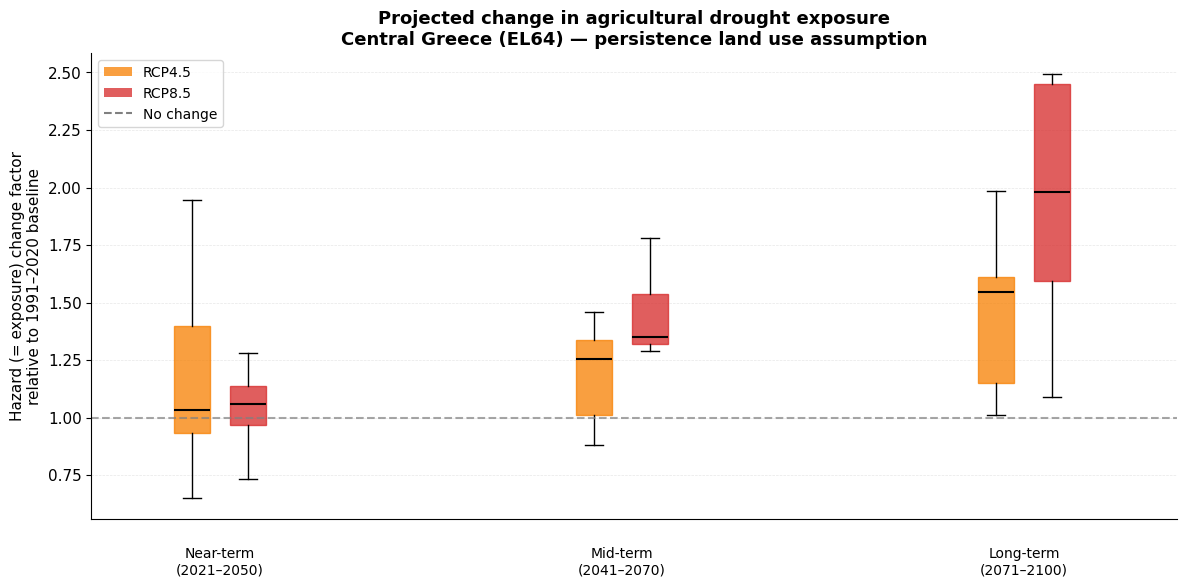
Figure: Multi-model spread of the hazard (= exposure) change factor for near-, mid-, and long-term future periods relative to the 1991–2020 baseline, for RCP4.5 (orange) and RCP8.5 (red). Under the persistence land use assumption, the exposure change factor equals the hazard change factor. A value of 1.0 indicates no change from the baseline; values above 1.0 indicate more agricultural drought exposure. Each box spans the 25th–75th percentile of the climate model ensemble; the horizontal line shows the median.
Part 3: Uncertainty from Agricultural Land Use Scenarios
The persistence assumption is a simplification. Future agricultural land use may change due to policy, economic, or demographic shifts. To explore sensitivity, we define four CORINE-based land use scenarios and combine each with both climate scenarios:
| Scenario | Agricultural fraction to 2100 |
|---|---|
| Persistence | Constant at 2018 CORINE value |
| Trend | Linear regression on 1990-2018 CORINE data, extrapolated to 2100 |
| +10% by 2100 | Linear increase from 2018 value to +10% relative by 2100 |
| -10% by 2100 | Linear decrease from 2018 value to -10% relative by 2100 |
For each scenario and RCP we compute the multi-model median and plot all eight combinations together, enabling a direct visual comparison of climate-scenario uncertainty versus land-use trajectory uncertainty.
all_proj_years = np.array(sorted(drought_proj_df['year'].unique()))
year_ref  = last_corine_year   # 2018
year_end  = 2100
frac_2018 = ag_frac_corine_dict[year_ref]  # observed CORINE value at last snapshot

# Linear trend fit on CORINE snapshots (for trend extrapolation post-2018)
slope, intercept, *_ = stats.linregress(df_corine['year'].values, df_corine['ag_fraction'].values)

# All four scenarios:
#   - For years up to and including 2018: use the full observed CORINE timeseries
#   - For years after 2018: apply the scenario-specific trajectory
frac_persistence, frac_trend, frac_plus10, frac_minus10 = {}, {}, {}, {}

for yr in all_proj_years:
    if yr <= year_ref:
        obs = ag_frac_corine_dict[yr]
        frac_persistence[yr] = obs
        frac_trend[yr]        = obs
        frac_plus10[yr]       = obs
        frac_minus10[yr]      = obs
    else:
        t = (yr - year_ref) / (year_end - year_ref)          # linear ramp 0 → 1
        frac_persistence[yr] = frac_2018
        frac_trend[yr]       = max(0.0, slope * yr + intercept)
        frac_plus10[yr]      = frac_2018 * (1 + 0.10 * t)
        frac_minus10[yr]     = frac_2018 * (1 - 0.10 * t)

scenarios_land = {
    'Persistence':  frac_persistence,
    'Trend':        frac_trend,
    '+10% by 2100': frac_plus10,
    '-10% by 2100': frac_minus10,
}

print(f'CORINE linear trend: {slope*10:.4f} fraction-points / decade')
print(f'  At 2018: {(slope*2018+intercept)*100:.2f}%  (CORINE actual: {frac_2018*100:.2f}%)')
print(f'\nLand use fractions at year 2100:')
for name, frac_dict in scenarios_land.items():
    print(f'  {name}: {frac_dict[2100]*100:.2f}%')
CORINE linear trend: -0.0065 fraction-points / decade
At 2018: 31.66% (CORINE actual: 31.75%)
Land use fractions at year 2100:
Persistence: 31.75%
Trend: 26.32%
+10% by 2100: 34.92%
-10% by 2100: 28.57%
We plot the four trajectories together with the five CORINE snapshot observations, so the assumed future paths can be compared directly against the historical record.
fig, ax = plt.subplots(figsize=(13, 5))

ls_map = {'Persistence': '-', 'Trend': '--', '+10% by 2100': ':', '-10% by 2100': '-.'}
hist_mask   = all_proj_years <= year_ref
future_mask = all_proj_years >= year_ref   # includes 2018 so lines connect

# Historical section: all scenarios are identical (observed CORINE), plot once
hist_ys = np.array([frac_persistence[yr] * 100 for yr in all_proj_years[hist_mask]])
ax.plot(all_proj_years[hist_mask], hist_ys,
        color='#8B4513', linewidth=2.5, label='Observed (CORINE, forward-filled)')

# CORINE snapshot dots
ax.scatter(df_corine['year'], df_corine['ag_fraction'] * 100,
           color='#8B4513', s=70, zorder=10, label='CORINE snapshots', marker='o')

# Future section: four diverging scenarios
for name, frac_dict in scenarios_land.items():
    ys = np.array([frac_dict[yr] * 100 for yr in all_proj_years[future_mask]])
    ax.plot(all_proj_years[future_mask], ys,
            linestyle=ls_map[name], color='#333333', linewidth=2, label=name)

ax.axvline(year_ref, color='gray', linestyle=':', linewidth=1.2, alpha=0.7,
           label=f'Last CORINE observation ({year_ref})')
ax.set_ylabel('Agricultural fraction (%)', fontsize=11)
ax.set_xlabel('Year', fontsize=11)
ax.set_title(
    f'Agricultural land fraction — {admin_id}\n'
    'Observed history (CORINE) and four future scenarios',
    fontsize=12, fontweight='bold'
)
ax.legend(fontsize=10)
ax.grid(True, alpha=0.3, linestyle='--')
ax.spines['top'].set_visible(False)
ax.spines['right'].set_visible(False)
plt.tight_layout()
plt.show()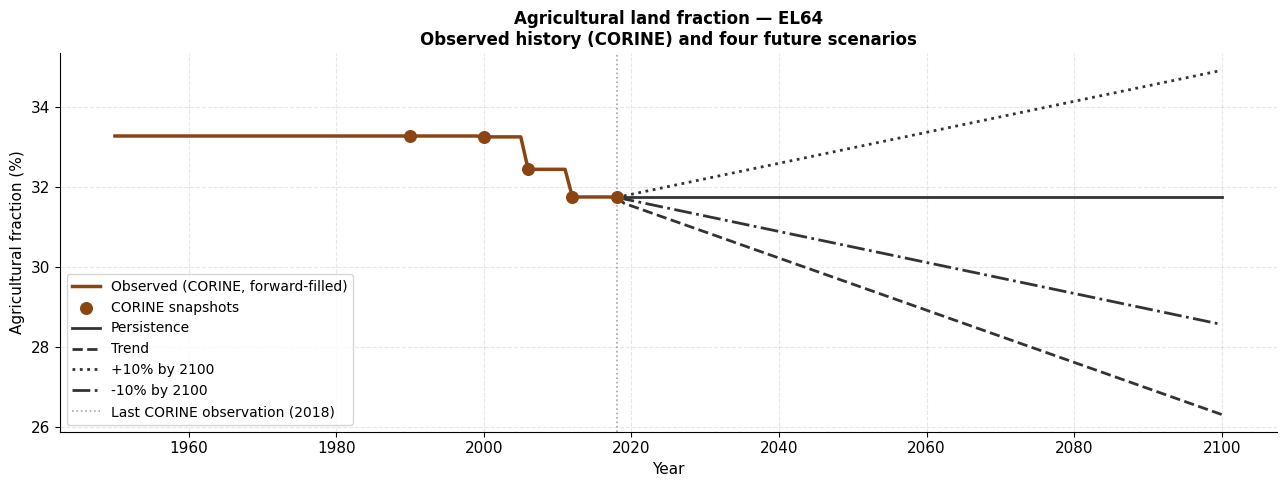
Figure: Agricultural land fraction for Central Greece (EL64). The brown solid line shows the observed CORINE timeseries (five snapshots forward-filled to 2018); brown dots mark the snapshot years. After 2018 (dotted vertical line), the four scenarios diverge: persistence (solid black), linear trend extrapolated from the 1990–2018 CORINE snapshots (dashed), +10% relative by 2100 (dotted), and −10% relative by 2100 (dash-dot). All scenarios share the same observed history before 2018.
We reuse make_exposure_stats from Part 2 to compute exposure for all 4 × 2 = 8 scenario combinations. The same order of operations applies: year-by-year product of dmd × ag_frac, then a 30-year rolling mean on the exposure series, then multi-model aggregation.
# Reuse make_exposure_stats from Part 2 — same order of operations:
# year-by-year product (dmd × ag_frac), then 30-yr rolling mean, then multi-model stats.
results_all = {}
for land_name, frac_dict in scenarios_land.items():
    for rcp in ['RCP4_5', 'RCP8_5']:
        _, results_all[(land_name, rcp)] = make_exposure_stats(drought_proj_df, frac_dict, rcp)

print('Exposure timeseries computed for all 4 land scenarios × 2 RCPs.')
Exposure timeseries computed for all 4 land scenarios × 2 RCPs.
The final chart overlays all eight scenario combinations into a single view: colour encodes the emission scenario (orange for RCP4.5, red for RCP8.5) and line style encodes the land use trajectory.
fig, ax = plt.subplots(figsize=(15, 7))

ax.plot(hist_corine_smooth['year'], hist_corine_smooth['exposure'],
        color='black', linewidth=2.5, label='Historical (reanalysis, CORINE)', zorder=10)

rcp_colors = {'RCP4_5': '#F77F00', 'RCP8_5': '#D62828'}
rcp_labels = {'RCP4_5': 'RCP4.5', 'RCP8_5': 'RCP8.5'}
ls_map = {'Persistence': '-', 'Trend': '--', '+10% by 2100': ':', '-10% by 2100': '-.'}

years_proj = results_all[('Persistence', 'RCP4_5')]['year'].values

for rcp in ['RCP4_5', 'RCP8_5']:
    color = rcp_colors[rcp]

    # Envelope spanning all land scenarios (multi-model median range)
    all_medians = np.vstack(
        [results_all[(ls, rcp)].set_index('year')['exposure_median'].reindex(years_proj).values
         for ls in scenarios_land]
    )
    ax.fill_between(years_proj, all_medians.min(axis=0), all_medians.max(axis=0),
                    color=color, alpha=0.12)

    # Climate model spread (P17-P83) for persistence scenario
    ts_pers = results_all[('Persistence', rcp)]
    ax.fill_between(ts_pers['year'], ts_pers['exposure_p17'], ts_pers['exposure_p83'],
                    color=color, alpha=0.07, hatch='//')

    # Individual land scenario lines
    for land_name, ls in ls_map.items():
        ts = results_all[(land_name, rcp)]
        ax.plot(ts['year'], ts['exposure_median'],
                color=color, linewidth=1.6, linestyle=ls, alpha=0.9)

ax.axvspan(baseline_start, baseline_end, color='gray', alpha=0.08)
ax.axvline(year_ref, color='gray', linestyle=':', linewidth=1.2, alpha=0.7)

ax.set_xlabel('Year', fontsize=12)
ax.set_ylabel('Agricultural drought exposure (months/yr\u00b7fraction)', fontsize=11)
ax.set_title(
    'Agricultural drought exposure |  RCP & land use scenario uncertainty\n'
    '(Central Greece (EL64),  CORINE-based land use scenarios,  30-year rolling mean)',
    fontsize=13, fontweight='bold'
)

legend_handles = [
    Line2D([0], [0], color='black', linewidth=2.5, label='Historical'),
    mpatches.Patch(facecolor='#F77F00', alpha=0.4, label='RCP4.5 (land scenario range)'),
    mpatches.Patch(facecolor='#D62828', alpha=0.4, label='RCP8.5 (land scenario range)'),
    mpatches.Patch(facecolor='gray', alpha=0.12, hatch='//', label='Climate model spread P17\u2013P83 (persistence)'),
    Line2D([0], [0], color='gray', linewidth=1.6, linestyle='-',  label='Persistence'),
    Line2D([0], [0], color='gray', linewidth=1.6, linestyle='--', label='Trend (extrapolated)'),
    Line2D([0], [0], color='gray', linewidth=1.6, linestyle=':',  label='+10% by 2100'),
    Line2D([0], [0], color='gray', linewidth=1.6, linestyle='-.', label='\u221210% by 2100'),
    mpatches.Patch(facecolor='gray', alpha=0.08, label=f'Baseline ({baseline_start}\u2013{baseline_end})'),
]
ax.legend(handles=legend_handles, loc='upper left', fontsize=9, frameon=True,
          framealpha=0.92, ncol=2)
ax.grid(True, alpha=0.3, linestyle='--', linewidth=0.5)
ax.spines['top'].set_visible(False)
ax.spines['right'].set_visible(False)
plt.tight_layout()
plt.show()
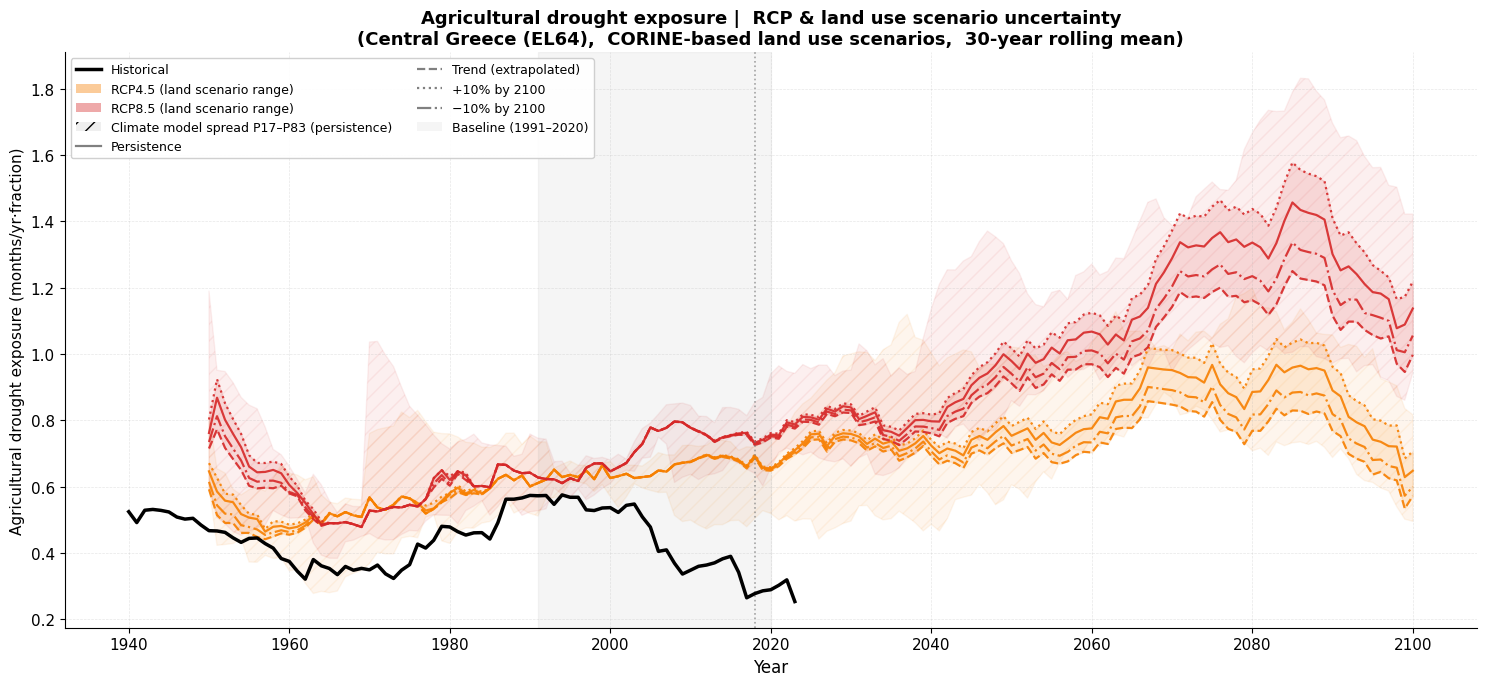
Figure: Agricultural drought exposure under combined climate and land use uncertainty for Central Greece (EL64). The black line shows historical exposure (ERA5 reanalysis × CORINE forward-fill). For each RCP scenario (orange: RCP4.5; red: RCP8.5), the light solid fill spans the range of multi-model median exposure across the four land use scenarios; the hatched fill shows the climate model spread (P17–P83) for the persistence scenario. Individual linestyles correspond to the four land use scenarios (solid: persistence; dashed: trend; dotted: +10%; dash-dot: −10%). All projection series use a 30-year rolling mean. The grey shading marks the 1991–2020 baseline period; the dotted vertical line marks 2018, the last CORINE observation.
Summary
This tutorial demonstrated how to estimate agricultural drought exposure by combining drought duration with agricultural land cover data.
Historical exposure
Both CORINE and satellite datasets capture the same drought signal but diverge in the absolute agricultural fraction, a known consequence of differences in classification methodology and spatial resolution.
The temporal pattern of agricultural drought exposure is consistent across both datasets.
Projected exposure
Holding agricultural fraction constant at the latest observed value, any increase in future exposure is driven entirely by climate change.
RCP8.5 leads to substantially higher agricultural drought exposure than RCP4.5 toward end-of-century.
Multi-model spread is considerable, highlighting uncertainty in the magnitude of future drought changes.
Land use scenario uncertainty
A +/-10% change in agricultural fraction by 2100 adds meaningful additional uncertainty, especially under RCP4.5 where climate uncertainty is smaller.
The extrapolated CORINE trend suggests a modest long-term decline in agricultural fraction, partially offsetting increasing drought hazard.
Emission-scenario choice (RCP4.5 vs. RCP8.5) remains the dominant source of uncertainty by end-of-century.
Outlook A complete agricultural drought risk assessment would additionally incorporate vulnerability (e.g., irrigation capacity, crop sensitivity, economic dependence on agriculture) and adaptation measures (e.g., drought-resistant crops, irrigation efficiency improvements).