This tutorial helps you understand agricultural land cover data using two complementary datasets: CORINE land cover and satellite-based land cover. You’ll explore and compare these datasets to understand their characteristics, differences, and temporal dynamics.
We’ll work with:
CORINE Land Cover: European land cover maps (1990, 2000, 2006, 2012, 2018) with detailed classification
Satellite Land Cover: Global satellite-based land cover (1992-2022) at 300m resolution
For more detail on what these datasets are, why they differ, and where they come from, see the Agricultural Land reference page.
Prerequisites: We’ll use preprocessed data for the region “Central Greece” (NUTS2 region “EL64”). If you change the region, please download and process the agricultural land data for your region using the how-to guides:
What you’ll learn:
Load and visualize agricultural land timeseries from CSV files
Explore spatial agricultural land distributions from raster data
Compare different land cover datasets (CORINE vs. satellite)
Understand temporal patterns in agricultural land changes
Create interactive maps of land cover
Setup
User settings
admin_id = "EL64" # Central GreeceLoad libraries
import xarray as xr
import numpy as np
import pandas as pd
import matplotlib.pyplot as plt
import geopandas as gpd
import regionmask
from pathlib import Path
import rioxarray as rxr
import os

# Set up data directories
data_dir = Path("../data")
corine_output_dir = data_dir / admin_id / "corine_land_cover"
satellite_output_dir = data_dir / admin_id / "satellite_land_cover"

print(f"\nData directories:")
print(f"  CORINE: {corine_output_dir}")
print(f"  Satellite: {satellite_output_dir}")
Data directories:
  CORINE: ../data/EL64/corine_land_cover
  Satellite: ../data/EL64/satellite_land_cover
Load region shapefile
# Read NUTS shapefiles
regions_dir = data_dir / 'regions'
nuts_shp = regions_dir / 'NUTS_RG_20M_2024_4326' / 'NUTS_RG_20M_2024_4326.shp'
nuts_gdf = gpd.read_file(nuts_shp)

# Select the region of interest
sel_gdf = nuts_gdf[nuts_gdf['NUTS_ID'] == admin_id]
print(f"Region: {sel_gdf['NUTS_NAME'].values[0]} ({admin_id})")
print(f"Country: {sel_gdf['CNTR_CODE'].values[0]}")
lon_min, lat_min, lon_max, lat_max = sel_gdf.geometry.total_bounds

# Create a regionmask from the admin region geometry
admin_mask = regionmask.from_geopandas(sel_gdf, names='NUTS_ID')
Region: Στερεά Ελλάδα (EL64)
Country: EL
Load Regional Agricultural Land Timeseries
First, let’s load the processed CSV files created by the how-to guides.
Load CORINE land cover data
Two CSV files are loaded: one with aggregated land cover percentages by main category (agricultural, forest, urban, water), and one with a finer breakdown of agricultural sub-types. Both are produced by the CORINE how-to guide.
# Load CORINE CSV files
csv_corine_categories = corine_output_dir / "land_cover_categories.csv"
csv_corine_agri = corine_output_dir / "agricultural_land_breakdown.csv"

# Read the data
df_corine_categories = pd.read_csv(csv_corine_categories)
df_corine_agri = pd.read_csv(csv_corine_agri)

print("CORINE land cover categories:")
print(f"  Years: {df_corine_categories['year'].min():.0f} - {df_corine_categories['year'].max():.0f}")
print(f"  Records: {len(df_corine_categories)}")
print(f"\nMain categories sample:")
print(df_corine_categories.head())
print(f"\nAgricultural breakdown sample:")
print(df_corine_agri.head())
CORINE land cover categories:
Years: 1990 - 2018
Records: 5
Main categories sample:
year agricultural forest urban water
0 1990 33.279219 62.715590 1.252794 1.067083
1 2000 33.257153 62.504301 1.510422 1.055861
2 2006 32.446728 62.442879 2.181934 1.109056
3 2012 31.755714 62.452383 2.562456 1.105405
4 2018 31.745346 62.425693 2.620222 1.105405
Agricultural breakdown sample:
year Non-irrigated arable Permanently irrigated Rice fields Vineyards \
0 1990 9.675677 3.523386 0.103912 0.095955
1 2000 9.678976 3.548181 0.072627 0.097757
2 2006 5.558817 7.323455 0.230085 0.091398
3 2012 5.307652 7.742775 0.228292 0.098860
4 2018 5.304568 7.733826 0.228292 0.098860
Fruit trees Olive groves Pastures Annual+permanent crops \
0 0.163262 4.380540 0.291327 0.104831
1 0.163391 4.374450 0.288768 0.104831
2 0.144353 4.734827 0.349343 0.104831
3 0.143172 5.271346 0.368523 0.100512
4 0.144966 5.271346 0.369299 0.100512
Complex cultivation Agriculture+natural Agro-forestry
0 6.282549 8.657781 0.0
1 6.244557 8.683615 0.0
2 5.813614 8.096005 0.0
3 5.582367 6.912215 0.0
4 5.582367 6.911311 0.0
Load satellite land cover data
The satellite CSV contains an annual agricultural fraction (0–1) for the region. We convert it to a percentage here so it is directly comparable to the CORINE values. The file is produced by the satellite land cover how-to guide.
# Load satellite CSV file
csv_satellite = satellite_output_dir / f"agricultural_land_fraction_{admin_id}.csv"

# Read the data
df_satellite = pd.read_csv(csv_satellite)
# Convert fraction to percentage for easier comparison
df_satellite['agricultural'] = df_satellite['ag_fraction'] * 100

print("Satellite land cover data:")
print(f"  Years: {df_satellite['year'].min():.0f} - {df_satellite['year'].max():.0f}")
print(f"  Records: {len(df_satellite)}")
print(f"\nSample:")
print(df_satellite.head())
Satellite land cover data:
Years: 1992 - 2022
Records: 31
Sample:
year ag_fraction agricultural
0 1992 0.304581 30.458114
1 1993 0.304572 30.457187
2 1994 0.304567 30.456723
3 1995 0.301157 30.115664
4 1996 0.298070 29.807042
Compare Agricultural Land Timeseries
Let’s visualize and compare the two datasets to understand their differences and similarities.
Visualize both datasets
The plot below overlays agricultural land coverage (as a percentage of the total region area) from CORINE and the satellite product. CORINE has five snapshots; the satellite dataset provides annual coverage from 1992 to 2022.
fig, ax = plt.subplots(figsize=(14, 6))

# Plot CORINE agricultural land
ax.plot(df_corine_categories['year'], df_corine_categories['agricultural'],
        marker='o', linewidth=2.5, markersize=10, label='CORINE Land Cover',
        color='#8B4513', linestyle='-', alpha=0.8)

# Plot satellite agricultural land
ax.plot(df_satellite['year'], df_satellite['agricultural'],
        marker='s', linewidth=2, markersize=6, label='Satellite Land Cover',
        color='#228B22', linestyle='--', alpha=0.8)

ax.set_xlabel('Year', fontsize=12)
ax.set_ylabel('Agricultural Land Coverage (%)', fontsize=12)
ax.set_title(f'Agricultural Land Change in {admin_id} - Dataset Comparison', fontsize=14, fontweight='bold')
ax.legend(fontsize=11, loc='upper left')
ax.grid(True, alpha=0.3)

plt.tight_layout()
plt.show()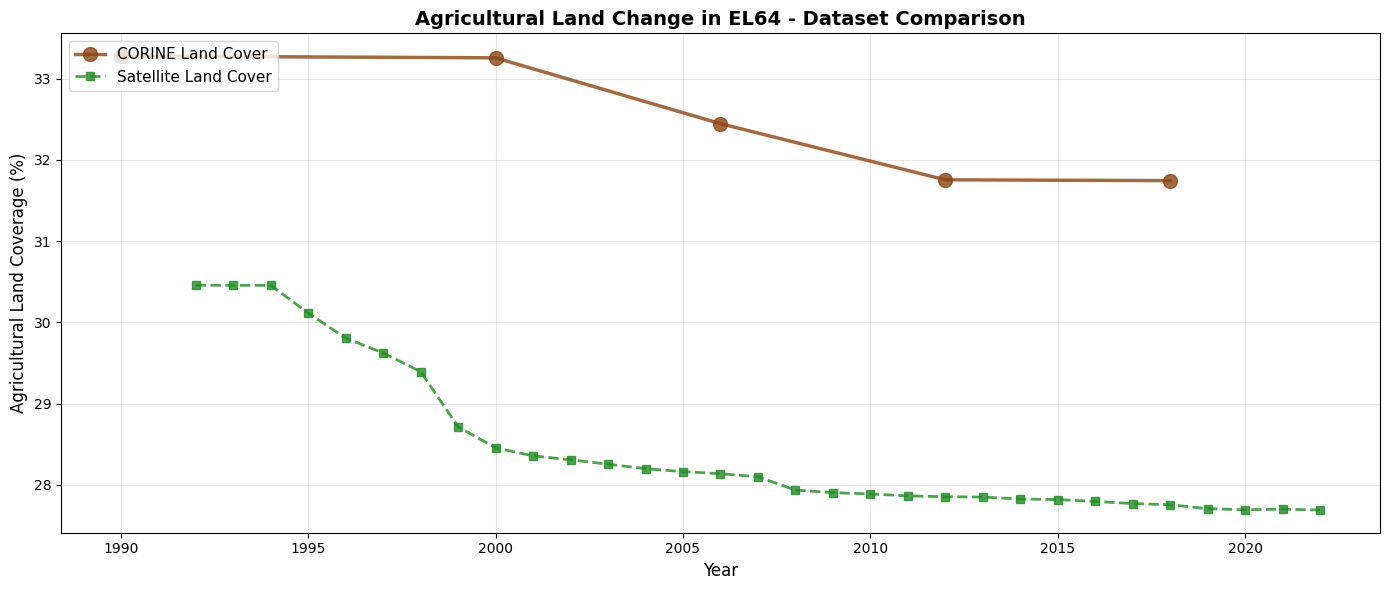
Figure: Agricultural land coverage (% of region) in Central Greece (EL64) over time. Brown markers show the five CORINE snapshots; green markers show the annual satellite-derived estimate. Both datasets capture the overall trend, but may differ in absolute values due to different classification methodologies.
Quantify differences
For overlapping years, let’s calculate the differences between the two datasets.
# Find overlapping years (CORINE years within satellite range)
corine_years = df_corine_categories['year'].values
satellite_years = df_satellite['year'].values

# Get closest satellite values for each CORINE year
comparison_data = []
for corine_year in corine_years:
    # Find exact match or closest year in satellite data
    if corine_year in satellite_years:
        sat_val = df_satellite[df_satellite['year'] == corine_year]['agricultural'].values[0]
        cor_val = df_corine_categories[df_corine_categories['year'] == corine_year]['agricultural'].values[0]

        comparison_data.append({
            'year': corine_year,
            'corine': cor_val,
            'satellite': sat_val,
            'difference': sat_val - cor_val,
            'percent_diff': ((sat_val - cor_val) / cor_val) * 100
        })

df_comparison = pd.DataFrame(comparison_data)

print("Dataset Comparison (overlapping years):")
print("="*90)
print(f"{'Year':<8} {'CORINE (%)':>12} {'Satellite (%)':>14} {'Diff (pp)':>12} {'Diff (%)':>12}")
print("-"*90)

for _, row in df_comparison.iterrows():
    print(f"{row['year']:<8.0f} {row['corine']:>12.2f} {row['satellite']:>14.2f} "
          f"{row['difference']:>12.2f} {row['percent_diff']:>11.2f}%")

print("\nSummary Statistics:")
print(f"  Mean absolute difference: {df_comparison['difference'].abs().mean():.2f} percentage points")
print(f"  Mean relative difference: {df_comparison['percent_diff'].abs().mean():.2f}%")
print(f"  Max difference: {df_comparison['difference'].abs().max():.2f} pp in {df_comparison.loc[df_comparison['difference'].abs().idxmax(), 'year']:.0f}")
Dataset Comparison (overlapping years):
==========================================================================================
Year CORINE (%) Satellite (%) Diff (pp) Diff (%)
------------------------------------------------------------------------------------------
2000 33.26 28.46 -4.80 -14.43%
2006 32.45 28.14 -4.31 -13.28%
2012 31.76 27.85 -3.90 -12.28%
2018 31.75 27.76 -3.99 -12.57%
Summary Statistics:
Mean absolute difference: 4.25 percentage points
Mean relative difference: 13.14%
Max difference: 4.80 pp in 2000
The table above quantifies the agreement between datasets for the years that both cover. Larger percentage differences in particular years can reflect genuine changes in the agricultural boundary definition or classification thresholds rather than real land-use change.
Explore CORINE Land Cover Categories
CORINE provides detailed information about different land cover types beyond just agricultural land.
Plot all land cover categories
Beyond agricultural land, CORINE tracks forests, urban areas, and water bodies. Plotting all categories together shows how land cover has shifted over the five CORINE epochs and puts agricultural changes in context.
fig, ax = plt.subplots(figsize=(14, 6))

ax.plot(df_corine_categories['year'], df_corine_categories['agricultural'],
        marker='o', linewidth=2.5, markersize=8, label='Agricultural', color='#8B4513')
ax.plot(df_corine_categories['year'], df_corine_categories['forest'],
        marker='s', linewidth=2.5, markersize=8, label='Forest', color='#228B22')
ax.plot(df_corine_categories['year'], df_corine_categories['urban'],
        marker='^', linewidth=2.5, markersize=8, label='Urban', color='#808080')
ax.plot(df_corine_categories['year'], df_corine_categories['water'],
        marker='d', linewidth=2.5, markersize=8, label='Water', color='#4169E1')

ax.set_xlabel('Year', fontsize=12)
ax.set_ylabel('Land Cover (%)', fontsize=12)
ax.set_title(f'Land Cover Change Over Time in {admin_id}', fontsize=14, fontweight='bold')
ax.legend(fontsize=11)
ax.grid(True, alpha=0.3)

plt.tight_layout()
plt.show()

# Print trends
print("Land Cover Trends (1990 to 2018):")
for category in ['agricultural', 'forest', 'urban', 'water']:
    start_val = df_corine_categories[category].iloc[0]
    end_val = df_corine_categories[category].iloc[-1]
    change = end_val - start_val
    print(f"  {category.capitalize()}: {start_val:.2f}% → {end_val:.2f}% (change: {change:+.2f} pp)")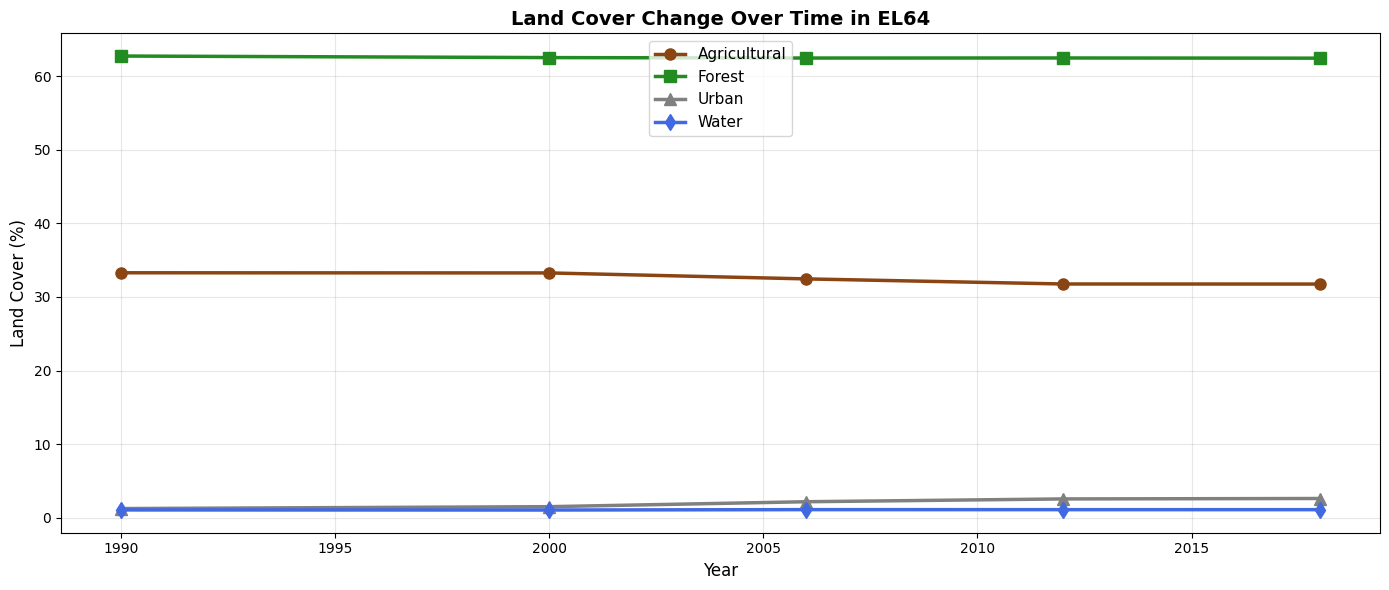
Land Cover Trends (1990 to 2018):
  Agricultural: 33.28% → 31.75% (change: -1.53 pp)
  Forest: 62.72% → 62.43% (change: -0.29 pp)
  Urban: 1.25% → 2.62% (change: +1.37 pp)
  Water: 1.07% → 1.11% (change: +0.04 pp)
Figure: CORINE land cover categories for Central Greece (EL64) across the five available years (1990–2018). The percentage change between the first and last year is printed below the figure.
Detailed agricultural land breakdown
CORINE distinguishes up to 11 agricultural sub-types (arable land, vineyards, olive groves, pastures, etc.). The stacked area chart shows the relative contribution of each sub-type and how the composition has changed over time.
# Stacked area plot of agricultural land types
fig, ax = plt.subplots(figsize=(14, 7))

# Prepare data for stacking
agri_cols = [col for col in df_corine_agri.columns if col != 'year']
years = df_corine_agri['year'].values

# Create stacked area plot
ax.stackplot(years,
             *[df_corine_agri[col].values for col in agri_cols],
             labels=agri_cols,
             alpha=0.8)

ax.set_xlabel('Year', fontsize=12)
ax.set_ylabel('Agricultural Land Coverage (%)', fontsize=12)
ax.set_title(f'Agricultural Land Types Over Time in {admin_id}', fontsize=14, fontweight='bold')
ax.legend(loc='center left', bbox_to_anchor=(1, 0.5), fontsize=9)
ax.grid(True, alpha=0.3, axis='y')

plt.tight_layout()
plt.show()

# Print summary of agricultural types
print("\nAgricultural land types (2018):")
latest_agri = df_corine_agri.iloc[-1]
for col in agri_cols:
    val = latest_agri[col]
    if val > 0.5:  # Only show significant types
        print(f"  {col}: {val:.2f}%")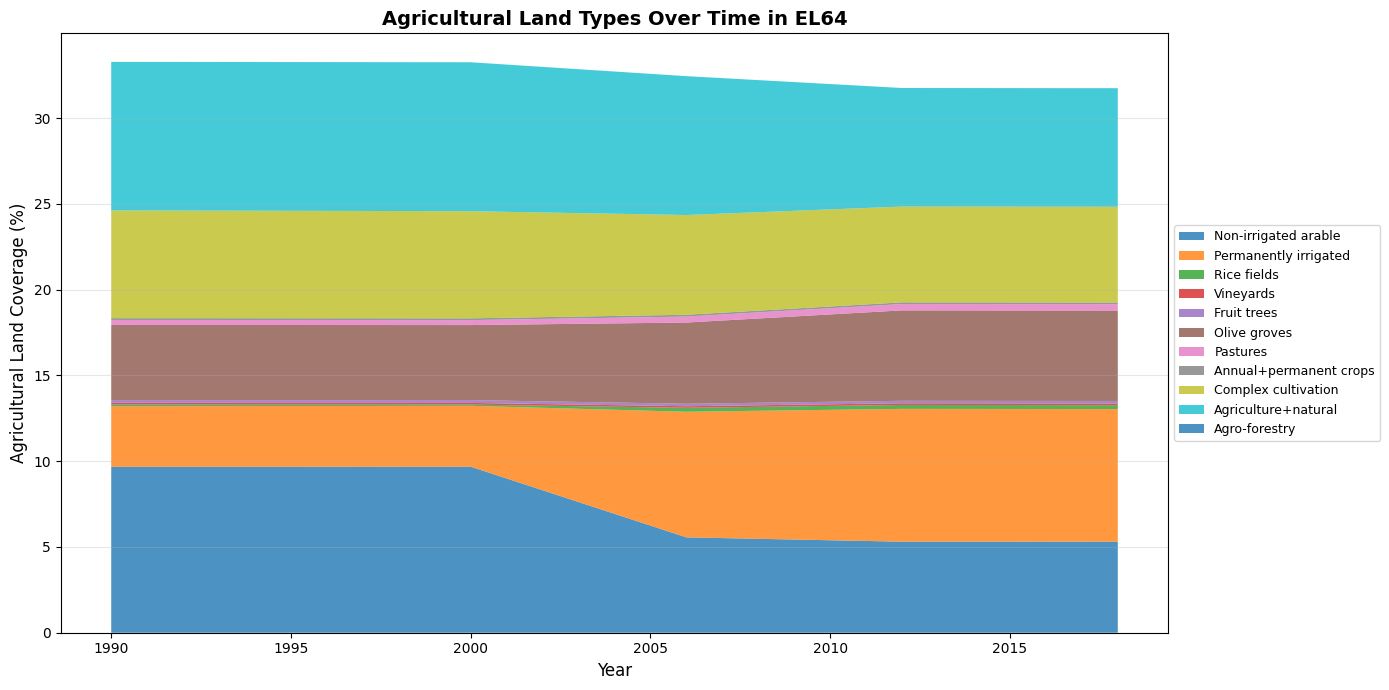
Agricultural land types (2018):
  Non-irrigated arable: 5.30%
  Permanently irrigated: 7.73%
  Olive groves: 5.27%
  Complex cultivation: 5.58%
  Agriculture+natural: 6.91%
Figure: Stacked area chart of CORINE agricultural sub-types for Central Greece (EL64), 1990–2018. Each coloured band represents one agricultural class; the total height is the overall agricultural fraction. The dominant sub-types for the latest year are printed below.
Interactive Map of CORINE Land Cover
To understand the spatial distribution of agricultural land, we load the CORINE raster for the latest year (2018) and render it as an interactive map. Agricultural pixels (CORINE classes 12–22) are highlighted with a heatmap overlay; the underlying basemap can be toggled between OpenStreetMap, satellite imagery, and topography.
# Install folium if not available
try:
    import folium
    from folium import plugins
except ImportError:
    !pip install folium
    import folium
    from folium import plugins
# Load CORINE land cover raster (latest year)
corine_tif = corine_output_dir / f"corine_landcover_{admin_id}.tif"
corine_raster = rxr.open_rasterio(corine_tif)
corine_raster = corine_raster.squeeze()
print(f"Loaded CORINE raster: {corine_tif.name}")
print(f"Shape: {corine_raster.shape}")
print(f"Coordinate ranges: lon=[{float(corine_raster.x.min()):.2f}, {float(corine_raster.x.max()):.2f}], lat=[{float(corine_raster.y.min()):.2f}, {float(corine_raster.y.max()):.2f}]")
print(f"Unique classes present: {np.unique(corine_raster.values[~np.isnan(corine_raster.values)])}")Loaded CORINE raster: corine_landcover_EL64.tif
Shape: (1650, 3105)
Coordinate ranges: lon=[21.26, 24.79], lat=[37.93, 39.43]
Unique classes present: [ 1. 2. 3. 4. 5. 6. 7. 8. 9. 10. 11. 12. 13. 14. 15. 16. 17. 18.
19. 20. 21. 23. 24. 25. 26. 27. 28. 29. 30. 31. 32. 35. 37. 40. 41. 42.
43. 44.]
# Define CORINE class names and colors
corine_classes = {
    1: ('Continuous urban fabric', '#E6004D'),
    2: ('Discontinuous urban fabric', '#FF0000'),
    3: ('Industrial or commercial units', '#CC4DF2'),
    4: ('Road and rail networks', '#CC0000'),
    5: ('Port areas', '#E6CCCC'),
    6: ('Airports', '#E6CCE6'),
    7: ('Mineral extraction sites', '#A600CC'),
    8: ('Dump sites', '#A64DCC'),
    9: ('Construction sites', '#FF4DFF'),
    10: ('Green urban areas', '#FFA6FF'),
    11: ('Sport and leisure facilities', '#FFE6FF'),
    12: ('Non-irrigated arable land', '#FFFFA8'),
    13: ('Permanently irrigated land', '#FFFF00'),
    14: ('Rice fields', '#E6E600'),
    15: ('Vineyards', '#E68000'),
    16: ('Fruit trees and berry plantations', '#F2A64D'),
    17: ('Olive groves', '#E6A600'),
    18: ('Pastures', '#E6E64D'),
    19: ('Annual crops associated with permanent crops', '#FFE6A6'),
    20: ('Complex cultivation patterns', '#FFE6CC'),
    21: ('Land principally occupied by agriculture', '#F2CC80'),
    22: ('Agro-forestry areas', '#80FF00'),
    23: ('Broad-leaved forest', '#00A600'),
    24: ('Coniferous forest', '#4DFF00'),
    25: ('Mixed forest', '#CCF24D'),
    26: ('Natural grasslands', '#A6FF80'),
    27: ('Moors and heathland', '#A6E64D'),
    28: ('Sclerophyllous vegetation', '#A6F200'),
    29: ('Transitional woodland-shrub', '#00CCF2'),
    30: ('Beaches, dunes, sands', '#CCE6FF'),
    31: ('Bare rocks', '#4D4DFF'),
    32: ('Sparsely vegetated areas', '#CCCCCC'),
    33: ('Burnt areas', '#000000'),
    34: ('Glaciers and perpetual snow', '#4DFF4D'),
    35: ('Inland marshes', '#00CCF2'),
    36: ('Peat bogs', '#80F2E6'),
    37: ('Salt marshes', '#00FFA6'),
    38: ('Salines', '#A6FFE6'),
    39: ('Intertidal flats', '#E6F2FF'),
    40: ('Water courses', '#00CCF2'),
    41: ('Water bodies', '#80F2E6'),
    42: ('Coastal lagoons', '#00FFA6'),
    43: ('Estuaries', '#A6FFE6'),
    44: ('Sea and ocean', '#E6F2FF')
}

# Calculate center of region
center_lat = (lat_min + lat_max) / 2
center_lon = (lon_min + lon_max) / 2

# Create base map
m = folium.Map(
    location=[center_lat, center_lon],
    zoom_start=9,
    tiles=None
)

# Add basemap options
folium.TileLayer('OpenStreetMap', name='OpenStreetMap').add_to(m)
folium.TileLayer(
    tiles='https://server.arcgisonline.com/ArcGIS/rest/services/World_Imagery/MapServer/tile/{z}/{y}/{x}',
    attr='Esri World Imagery',
    name='Satellite',
    overlay=False,
    control=True
).add_to(m)
folium.TileLayer(
    tiles='https://server.arcgisonline.com/ArcGIS/rest/services/World_Topo_Map/MapServer/tile/{z}/{y}/{x}',
    attr='Esri World Topo',
    name='Topographic',
    overlay=False,
    control=True
).add_to(m)

# Add region boundary
folium.GeoJson(
    sel_gdf.geometry,
    name=f'Region {admin_id}',
    style_function=lambda x: {
        'fillColor': 'none',
        'color': 'red',
        'weight': 3,
        'fillOpacity': 0
    }
).add_to(m)

# Create a simplified overlay showing agricultural vs non-agricultural land
# Agricultural classes are 12-22
corine_array = corine_raster.values
y_coords = corine_raster.y.values
x_coords = corine_raster.x.values

# Create points for agricultural land (green) and other land (various colors)
agri_points = []
other_points = []

# Sample the data for performance (every 5th point)
step = 5
for i in range(0, len(y_coords), step):
    for j in range(0, len(x_coords), step):
        val = corine_array[i, j]
        if not np.isnan(val):
            val_int = int(val)
            if 12 <= val_int <= 22:  # Agricultural
                agri_points.append([y_coords[i], x_coords[j]])
            else:
                other_points.append([y_coords[i], x_coords[j]])

# Add heatmaps for agricultural land
if len(agri_points) > 0:
    plugins.HeatMap(
        agri_points,
        name='Agricultural Land',
        min_opacity=0.4,
        max_zoom=13,
        radius=12,
        blur=15,
        gradient={0.4: 'yellow', 0.6: 'orange', 0.8: '#8B4513', 1.0: '#654321'}
    ).add_to(m)

# Add layer control
folium.LayerControl().add_to(m)

# Add title
title_html = f'''
<div style="position: fixed;
     top: 10px; left: 50px; width: 450px; height: 70px;
     background-color: white; border:2px solid grey; z-index:9999;
     font-size:16px; padding: 10px; box-shadow: 2px 2px 6px rgba(0,0,0,0.3);
     border-radius: 5px;">
     <b>CORINE Land Cover - Agricultural Land Distribution</b><br>
     <span style="font-size:14px;">{admin_id} - Latest available (2018)</span><br>
     <i style="font-size:12px; color:#666;">Toggle layers and zoom to explore</i>
</div>
'''
m.get_root().html.add_child(folium.Element(title_html))

# Display map
mFigure: Interactive heatmap of CORINE agricultural land for Central Greece (EL64) in 2018. The orange–brown heatmap highlights pixels classified as agricultural (CORINE classes 12–22). Use the layer control (top right) to switch basemaps and zoom in to explore local patterns.
Key Takeaways
What have we learned about agricultural land cover data?
Temporal coverage differs: CORINE provides five high-quality snapshots (1990–2018); the satellite product gives annual values from 1992 to 2022.
Classification detail differs: CORINE distinguishes up to 11 agricultural sub-types; the satellite product reports a single agricultural fraction.
Both datasets agree on the trend, but absolute values can differ by several percentage points — neither is simply “more correct”; the choice depends on your use case.
Spatial patterns matter: the interactive map shows that agricultural land is not uniformly distributed — drought exposure will vary across the region depending on where crops are located.
Next step: see this data in action! The Agricultural land exposed to prolonged droughts tutorial combines the agricultural land data explored here with drought hazard projections to estimate how much cropland is exposed to drought under different climate scenarios.