Using only the packages imported and data loaded in the first code block, produce a figure similar to the one show below.
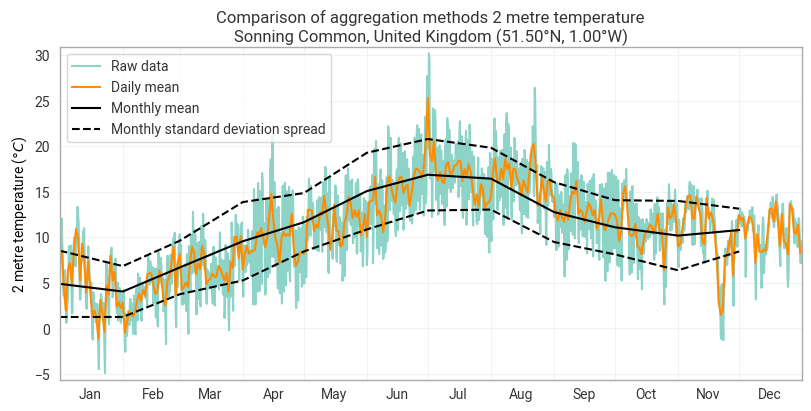
All the information and code required to complete this task can be found in the earthkit-transforms Documentation pages.
The following code cell imports the required earthkit modules and uses earthkit-data to download
the sample data.
The data is a grib file containing hourly 2m temperature data over Europe for the year 2015.
from earthkit.data.utils.testing import earthkit_remote_test_data_file

from earthkit import data as ekd
from earthkit import plots as ekp
from earthkit import transforms as ekt

# Get some demonstration ERA5 data, this could be any url or path to an ERA5 grib or netCDF file.
remote_era5_file = earthkit_remote_test_data_file("era5_temperature_europe_2015.grib")
era5_data = ekd.from_source("url", remote_era5_file)

era5_data
# Insert your code hereHints
Consider the following workflow:
Optional, convert to xarray to have more control on the dimensionality of the results.
Use the
earthkit.transforms.temporalsub-module to calculate the daily and monthly statisticsUse
earthkit.plots.Timeseriescharts to construct the plot